Why Pet Owners Don't Know About Purina: A Digital Analytics Story
Digital Analytics
SEO Strategy
Social Media Analysis
Duration
3 months, Spring 2026
Team
4 Product Experience Designers
Tools
SEMrush, SimilarWeb, manual analysis
Overview
Purina has strong brand authority, but it's not translating into purchase preference.
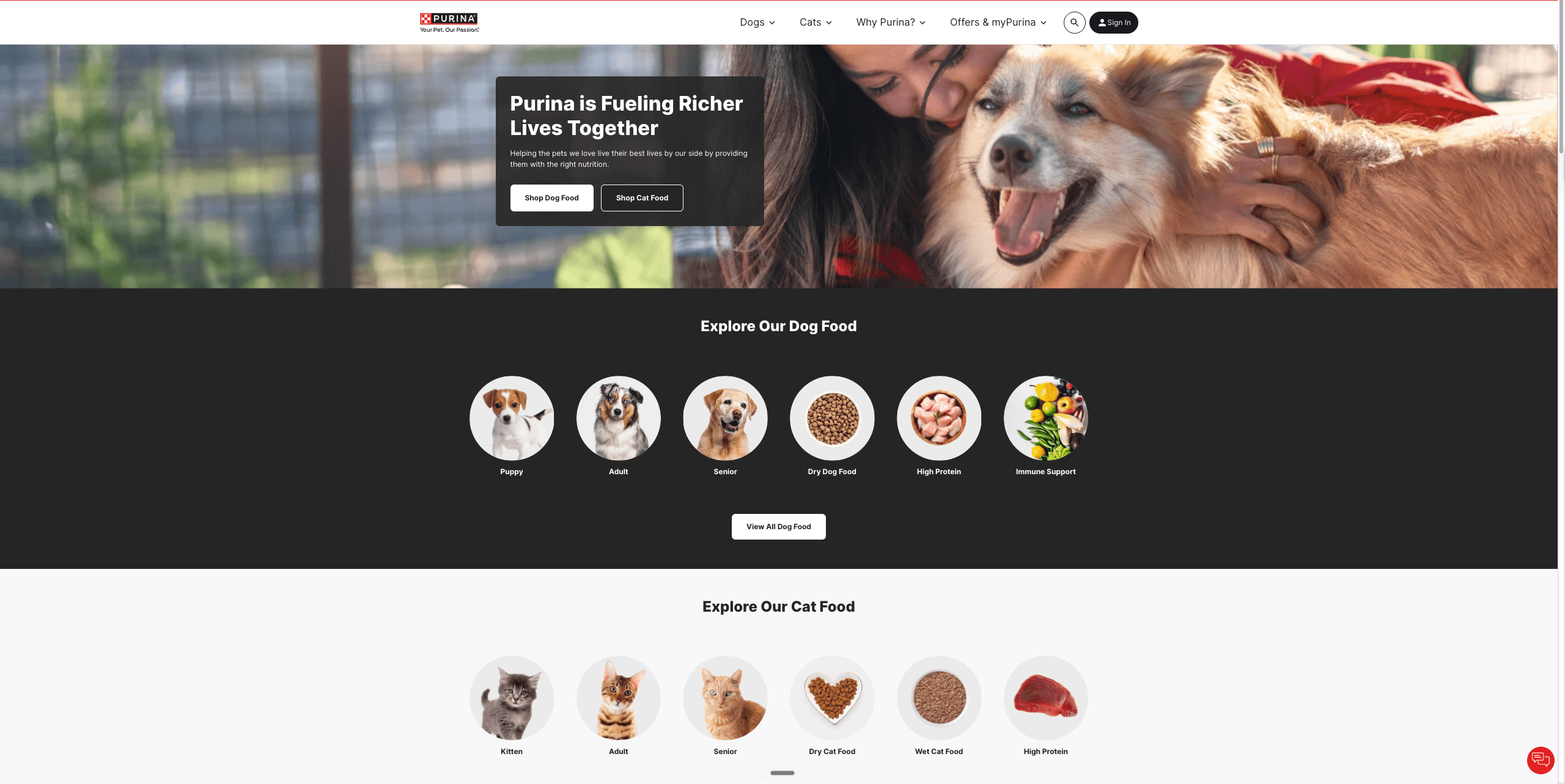
Purina manufactures pet food. It doesn't sell directly on its website; instead, products ship through retailers like Chewy, Amazon, Petsmart, and Walmart. This business model means Purina's digital success depends on building brand preference, not website traffic or direct conversions.
Here's the problem: None of us had ever heard of Purina, despite all owning pets and shopping at these retailers regularly. We assumed this was an awareness gap. Our audit revealed something deeper: a preference gap. Purina generates awareness (214K monthly social visits) but doesn't convert that awareness into the brand preference that influences retailer purchases.
Our question became:
Where are pet owners losing trust in Purina between first awareness and purchase intent?
Final Product
We approached this through SEO, website performance, and social media.
Our team conducted a comprehensive digital audit across 2 dimensions: website performance (SEO) and social media strategy. We used SEMrush for keyword and competitive analysis, SimilarWeb for traffic benchmarking, and manual analysis of social media platforms to understand performance patterns that tools alone couldn't reveal.

SEMrush dashboard for Purina.com
We benchmarked Purina against four competitors: Chewy (retailer and brand), Royal Canin, Blue Buffalo, and Hill's Pet Nutrition — comparing their keyword rankings, search intent coverage, and social engagement strategies.

What We Analyzed
Website Performance
1
Keyword gap analysis, search intent mapping, domain authority benchmarking, on-page SEO, off-page SEO, technical SEO, product discoverability pathways
Social Media Strategy
2
Platform performance analysis, content engagement by type, traffic conversion metrics [my primary focus]
Findings
The gaps appeared across three areas: search optimization, keyword strategy, and social media effectiveness.
1
SEO foundation is strong but missing strategic opportunities
Purina's SEO performance is adequate overall. The site has a strong technical foundation and authority, but optimization gaps prevent them from fully capitalizing on their position.
✅ What's working
Authority score of 74 (industry leader), 23,800+ referring domains, proper HTTPS/XML sitemap/robots.txt setup, and clear brand messaging in titles and meta descriptions.

⚠️ What needs Attention
Keyword gaps: Purina misses high-intent health keywords. Chewy dominates 484+ keywords Purina doesn't target; Blue Buffalo owns 274+. Critically, Purina is missing "senior dog gut health," "digestive upset solutions," and "sensitive stomach care"—areas where they have veterinary credibility but no content.

On-page inconsistencies: 38 pages missing meta descriptions, missing/multiple H1 tags, underutilized alt text, and low text-to-HTML ratios.
Internal linking: Some pages have only one internal link, 39 instances of non-descriptive anchor text.
On-page inconsistencies: 38 pages missing meta descriptions, missing/multiple H1 tags, underutilized alt text, and low text-to-HTML ratios.
Internal linking: Some pages have only one internal link, 39 instances of non-descriptive anchor text.


💡 The opportunity
Purina already attracts attention through strong pet care content. The site structure should guide users toward product discovery and purchase intent.
2
Instagram Drives Engagement, Not Action
I analyzed Purina's social media performance across platforms and found a critical disconnect.
Purina is most active on Instagram, with carousel posts averaging 1,722 likes and 44 comments — 10 times more engagement than reels (170 likes, 12 comments).

Purina's Instagram content
Yet Instagram accounts for only 7% of Purina's total social traffic. Meanwhile, Facebook (32%) and YouTube (24%) drive significantly more users to their website, despite generating less visible engagement.

⚠️ What needs Attention
Purina optimizes for vanity metrics (likes, shares) on the wrong platform. Their audience prefers carousels but doesn't follow through to conversion. They're winning engagement on a platform where purchase intent is lowest.

✅ What's working
When Purina posts collaborations, like the St. Louis Blues adoption event (6,638 likes) and Westminster Dog Show partnership (5,647 likes), engagement jumps 3-4x baseline.
People engage with Purina when the brand is part of something they care about, not when it's selling products.

3
Facebook Engagement is Being Wasted
Interestingly, Facebook shows higher engagement than Instagram (relative to post frequency), but for the wrong reasons. Facebook users comment more frequently — often with frustration.

✅ What's working
When customers complain about discontinued products, Purina responds with empathy, explains the decision thoughtfully, and recommends alternatives. This is excellent customer service, but it's not strategic engagement. They're managing crises instead of building preference.


Both Instagram and Facebook share identical content. The difference is that Facebook users feel comfortable complaining, while Instagram users scroll. Neither channel actively connects engagement to product discovery or retailer purchase links.
Recommendations
A 3 Phase Strategy: fix what's broken, expand strategically, and measure what matters.
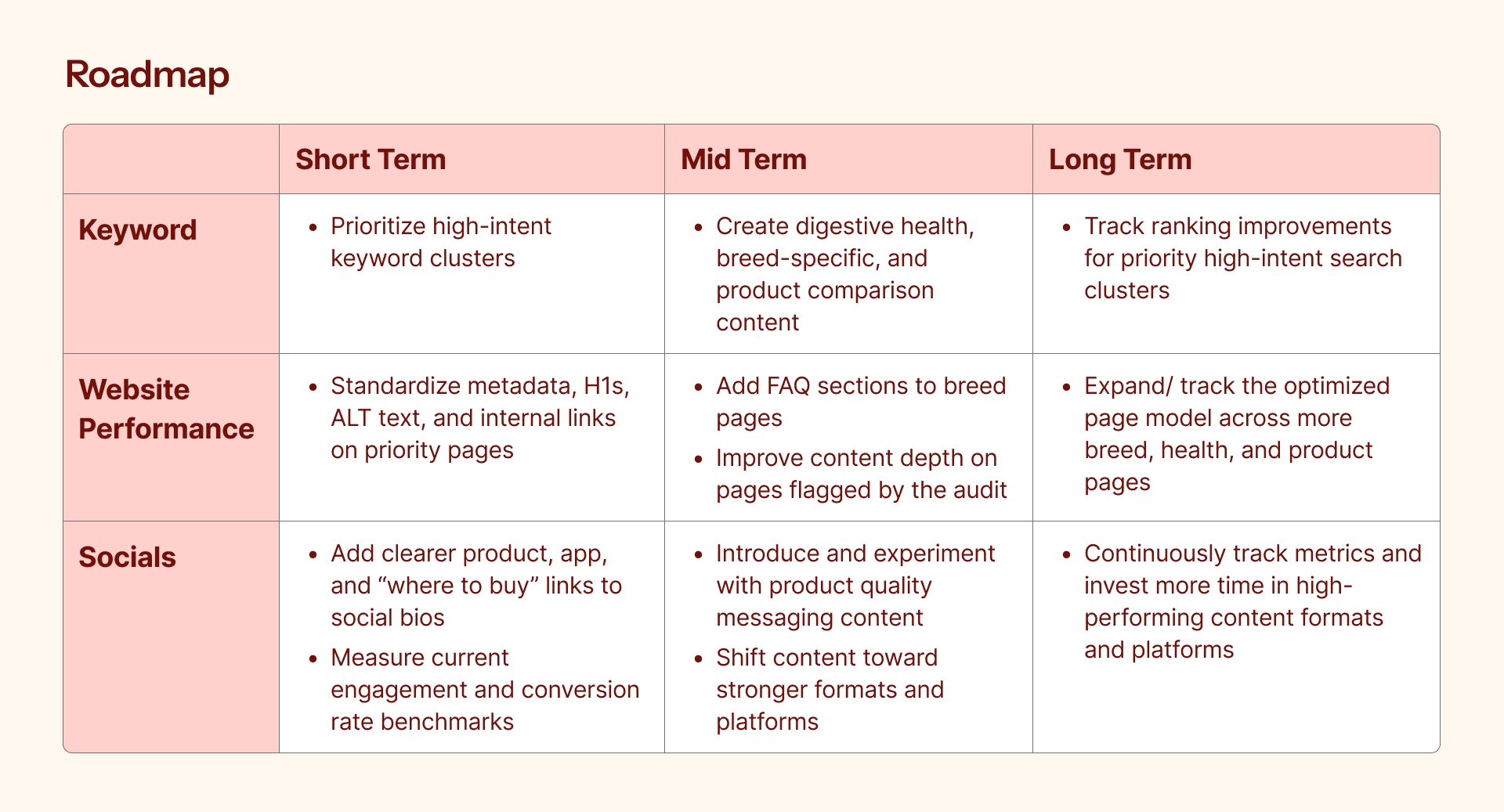
Suggested roadmap to repair Purina's current digital strategy
Short Term (Cleanup & Quick Wins)
For Keywords: Identify and prioritize high-intent keyword clusters (gut health, breed-specific, joint care) and create targeted landing pages.
For Website: Standardize metadata, H1s, alt text, and internal linking on priority product pages.
For Social Media: Add clearer CTAs to product pages, "where to buy" links, and set baseline engagement metrics and traffic conversion benchmarks.
Mid Term (Content Expansion)
For Keywords: Create digestive health, breed-specific, and product comparison content that explicitly ties Purina products to health solutions.
For Website: Develop FAQ sections on product pages; deepen content on pages flagged by the audit.
For Social Media: Test stronger product-quality messaging; shift budget away from Instagram toward Facebook and YouTube where purchase intent is higher; double down on carousel format (which outperforms trending reels for Purina's audience).
Long Term (Measurement & Scaling)
Track ranking improvements for priority keyword clusters; expand the optimized page model; continue monitoring which social formats actually drive product discovery and conversion intent.
Dashboard
To scale these changes, Purina needs visibility into what's actually working.
We recommended building a comprehensive analytics dashboard to track progress in real time. This isn't just a vanity metrics tracker—it's a decision-making tool.

Mockup of recommended dashboard
What the dashboard measures:
Why it matters
With visibility into engagement, acquisition, and conversion, teams can optimize toward high-intent opportunities and measure the gap closing with competitors over time.
Expected Impact
These changes would shift how pet owners discover and prefer Purina.
If implemented, these recommendations would likely:
1
Increase brand consideration in niche health categories where competitors currently dominate
2
Drive higher-intent traffic to retailer pages (when Purina products appear in Chewy/Amazon recommendations)
3
Improve keyword ranking in health-related searches, competing directly with Royal Canin and Blue Buffalo
4
Convert social engagement into preference, shifting from passive likes to active product searches
However, without knowing Purina's actual business priorities—whether they prioritize brand awareness over purchase consideration, or if they have retailer partnership data—these recommendations assume a balanced approach. A manufacturer's digital strategy looks fundamentally different depending on their goals.
Learnings
The hardest part wasn't finding the problems; it was understanding why they mattered.
1
This project taught me that digital strategy must align with business model. Purina's challenge wasn't generating traffic, it was building preference. For a B2B2C brand (manufacturer → retailer → consumer), success isn't measured by website conversions. It's measured by retailer sales and brand consideration at point of purchase.
2
It also reinforced that platform trends don't override audience behavior. Reels are the hot format, but Purina's audience prefers carousels. Sometimes the best strategy is doubling down on what works for your specific people, not what the platform recommends.
3
And finally: Context is everything. Without understanding Purina's actual business goals and retailer relationships, we could only make educated guesses about what strategy would work. The best recommendations come when you know not just the problem, but the business priorities behind it.