Improving Patient-Caregiver Communication for Healthcare Management
End-to-End Product Design
User Research
UI/UX Design
Mobile Application Design
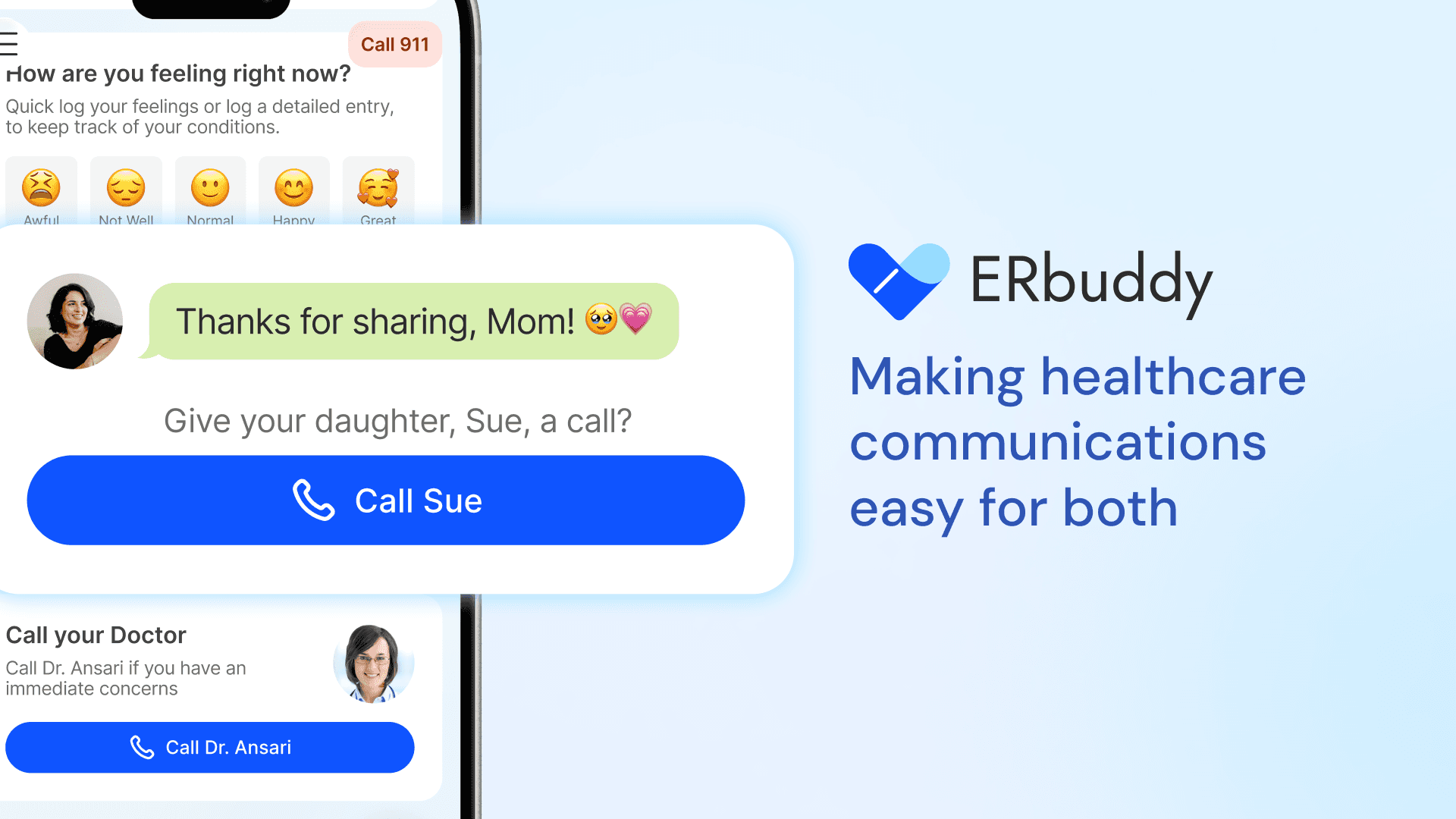
ERbuddy is a personal healthcare management platform designed for patients and their caregivers helping families manage chronic conditions and access critical health information.
I led research and design for ERbuddy's healthcare app redesign. Restructured IA, designed role-switching and health logging features, and validated solutions through usability testing with target users.
Duration
3 months, Spring 2025
Team
3 UX consultants at the DX Center at Pratt Institute
What I did
Project management, 7 user research sessions, and design lofi and hifi prototypes
Client

Problem
Does ERbuddy's features actually help families manage health conditions?
Early user feedback on their beta mobile app with medication reminders, medical history tracking, and appointment scheduling features revealed a critical insight: While the features existed, the team needed to understand whether the product truly solved user problems.
We set out to uncover deeper opportunities with 2 focus areas:
Centralize Information Access
Ensuring essential health information surfaces at the right time
Improve Usability and Accessibility
Design an intuitive, accessible interface that minimizes friction for all users
Final Design
Introducing 2 new features for instant updates and easier monitoring

The newly designed app creates a unified experience where caregivers and patients can access critical health information, communicate seamlessly, and manage care with less stress.
Newly introduced features include:
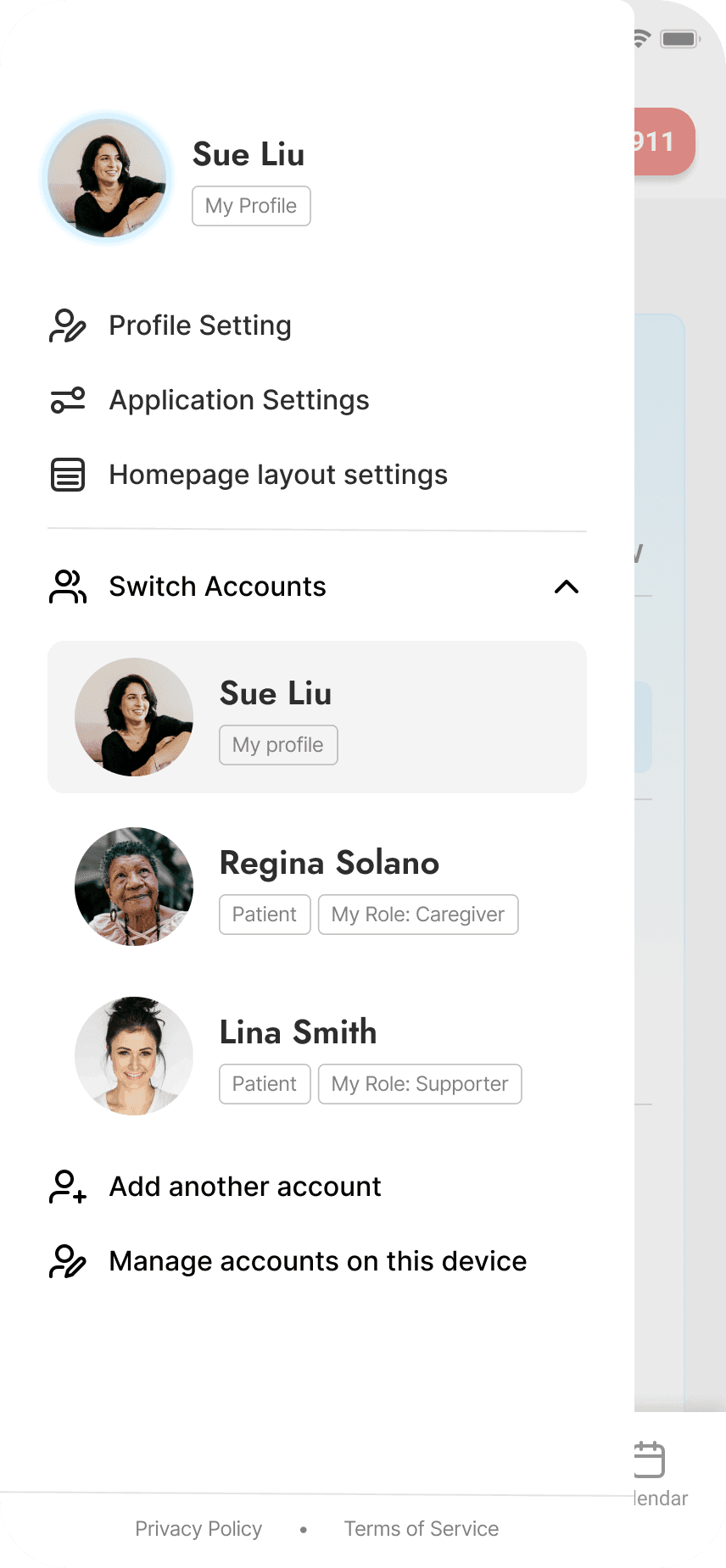
Centralized information for multi-roled caregivers
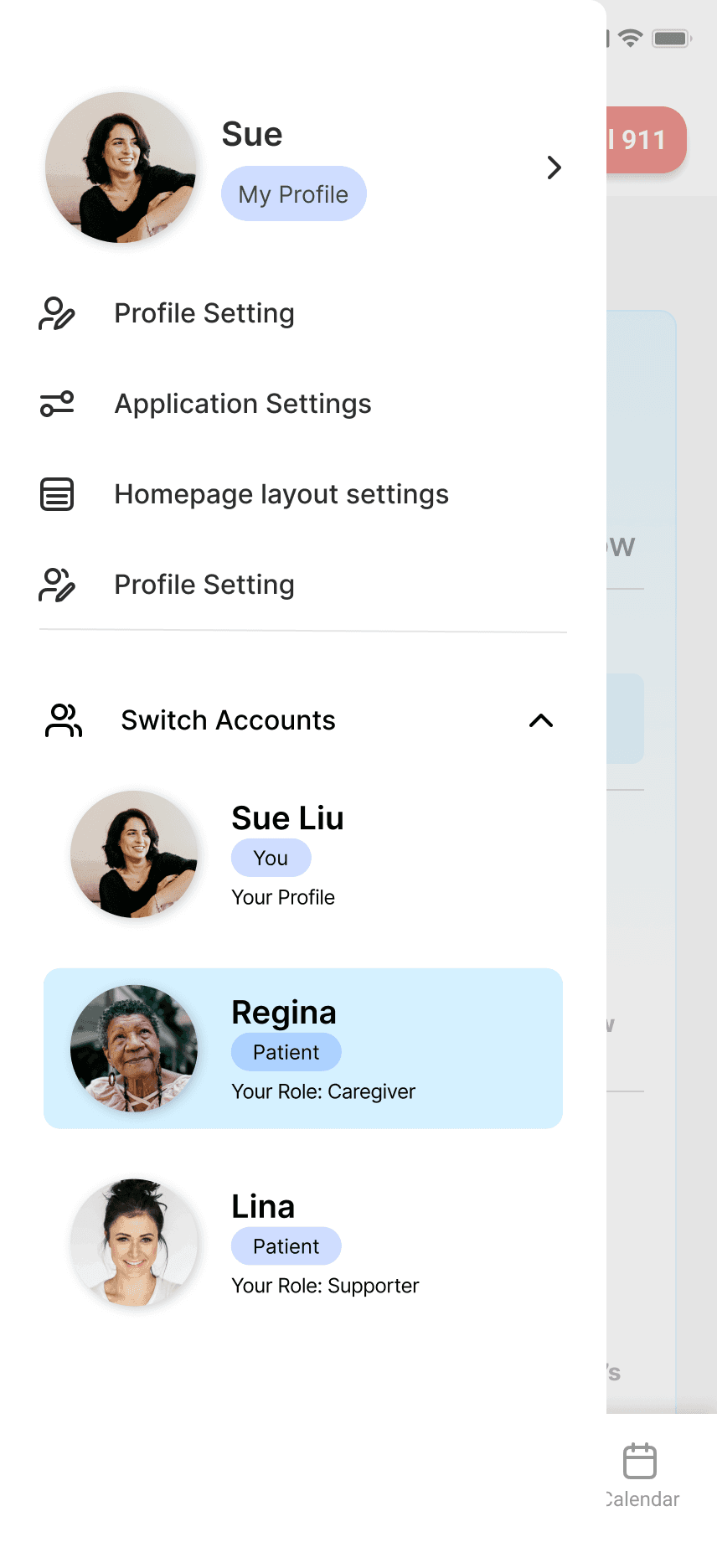
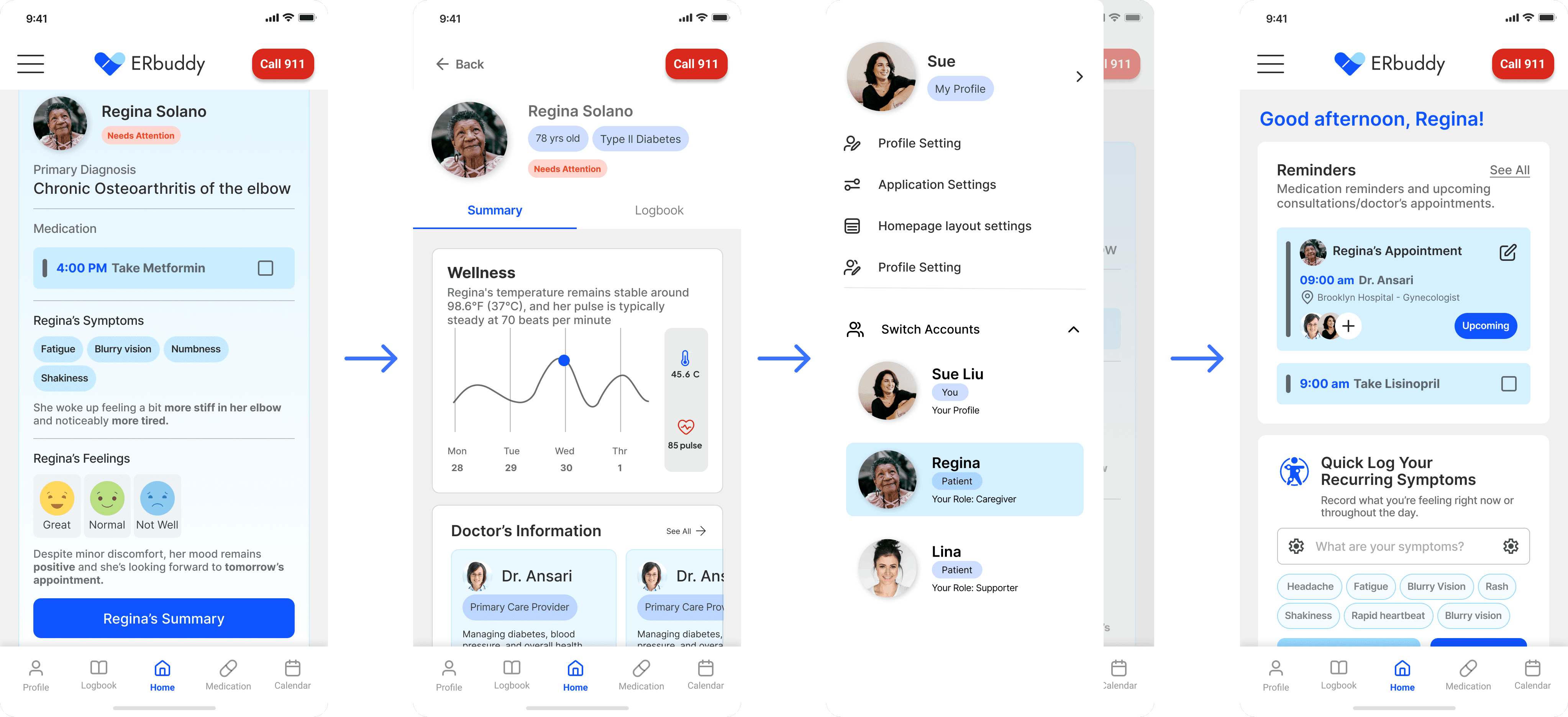
Caregivers can switch between profiles to monitor patient health and manage their own, without logging out.
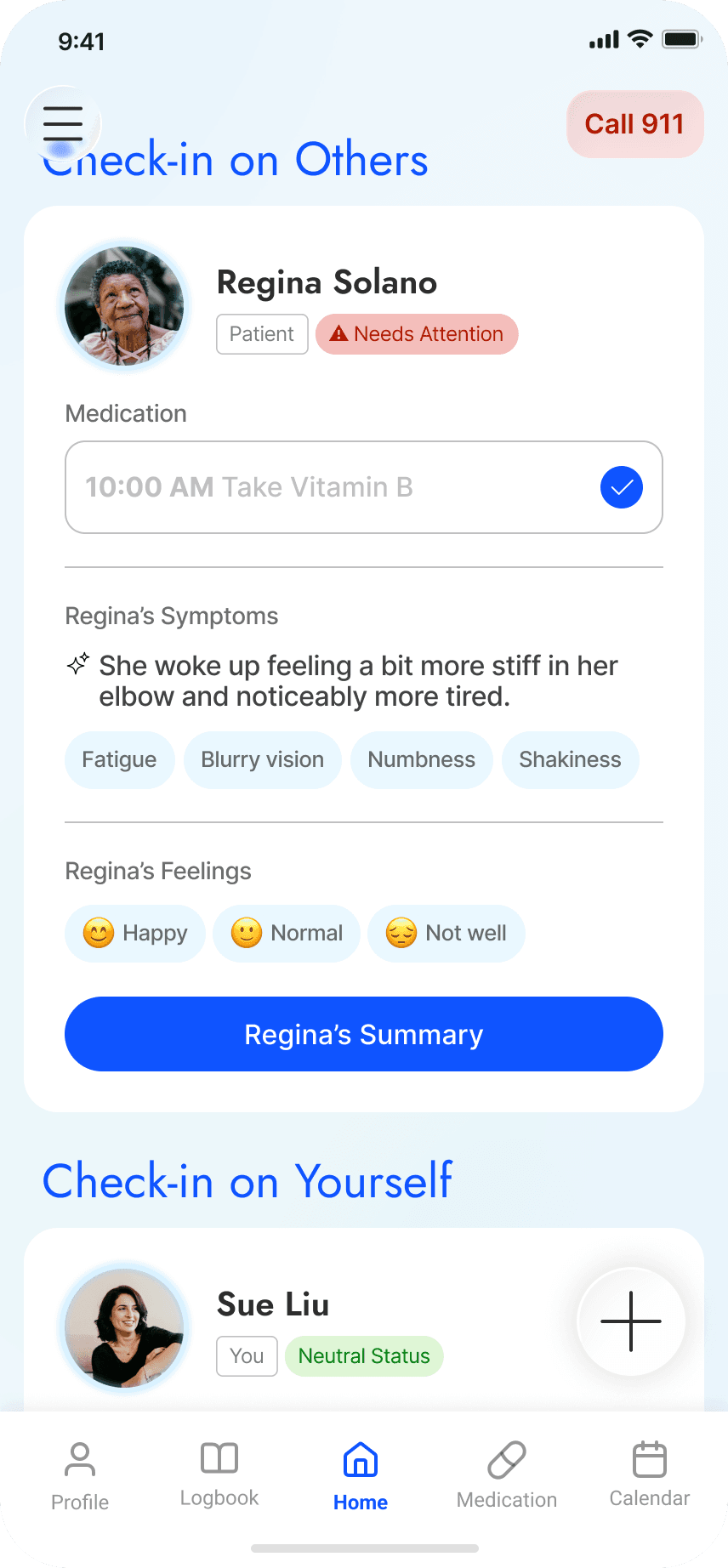
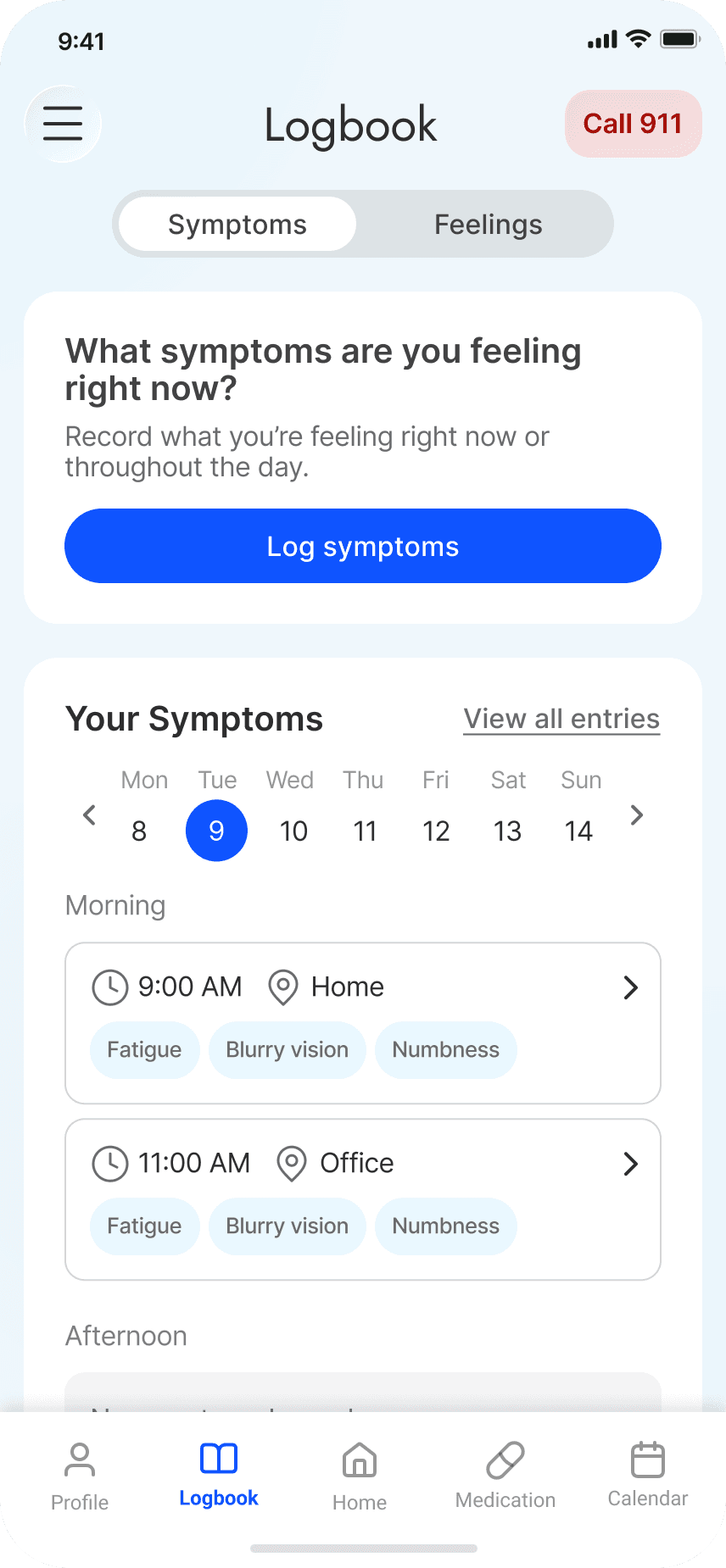
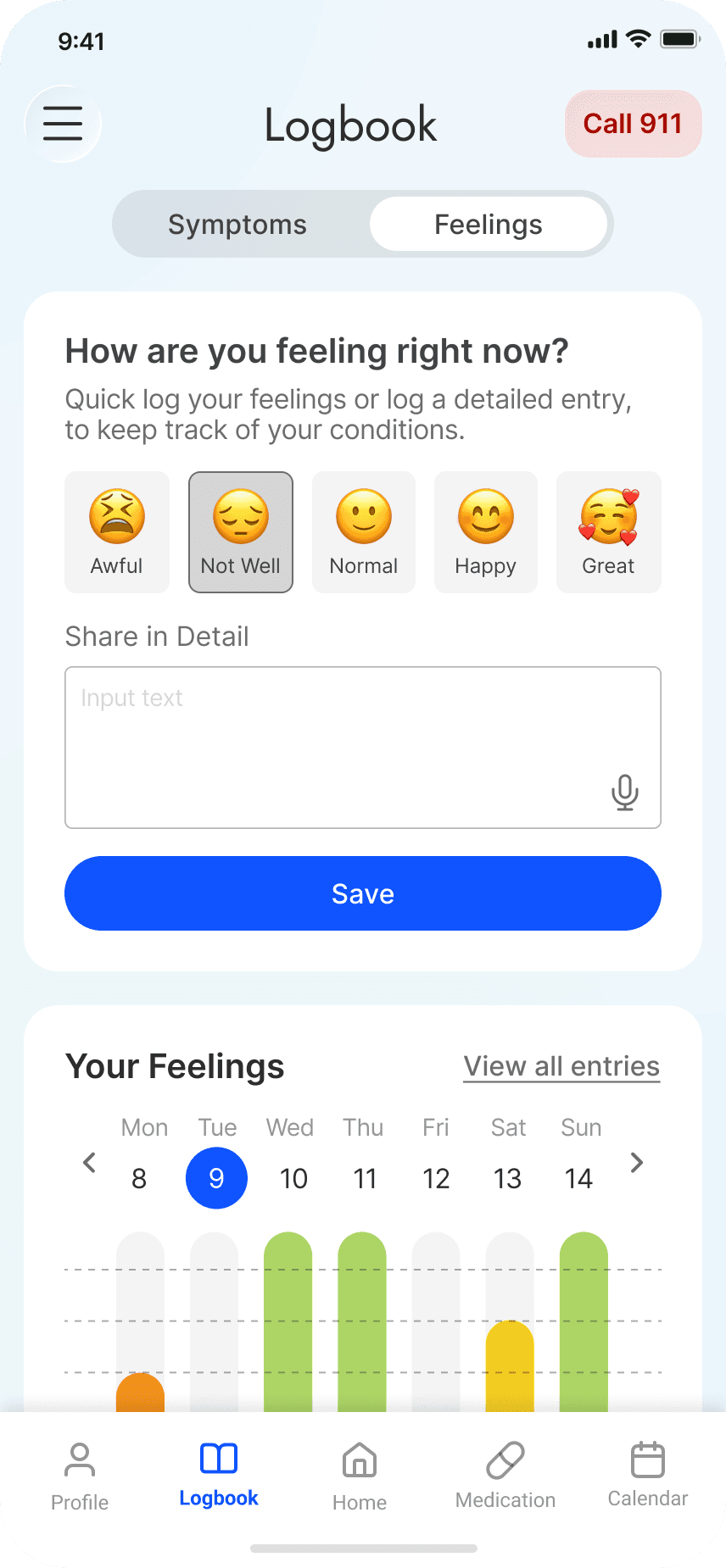
Patient Logbook
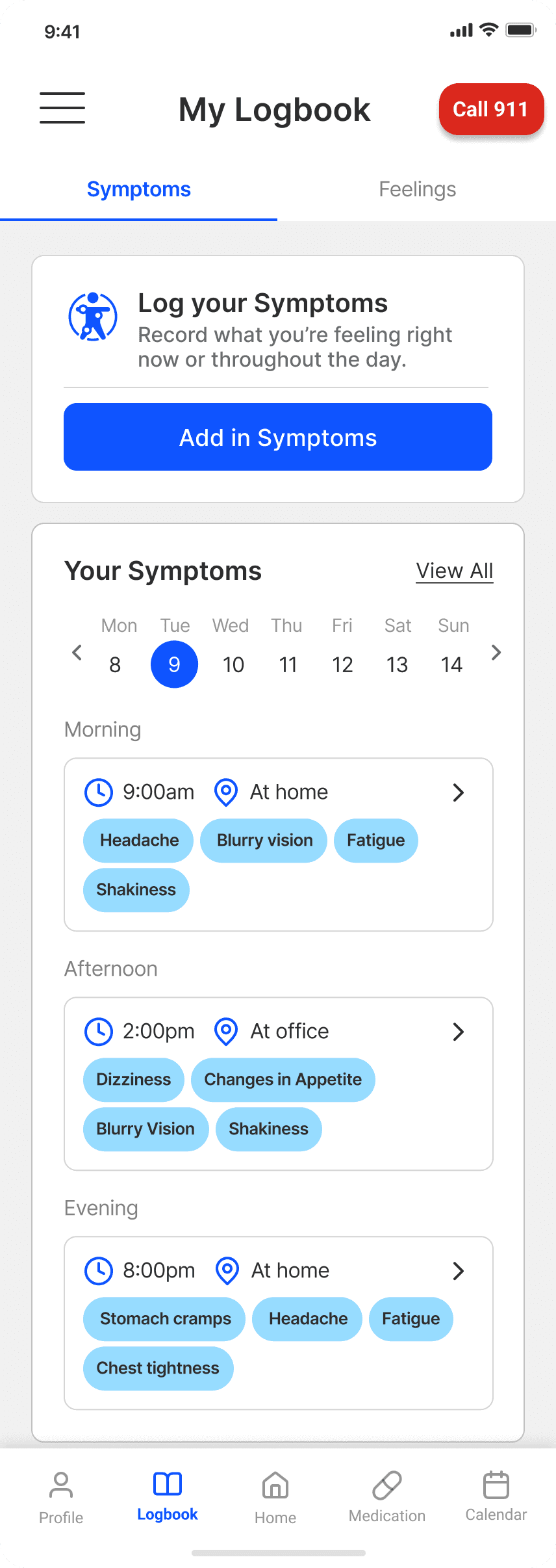
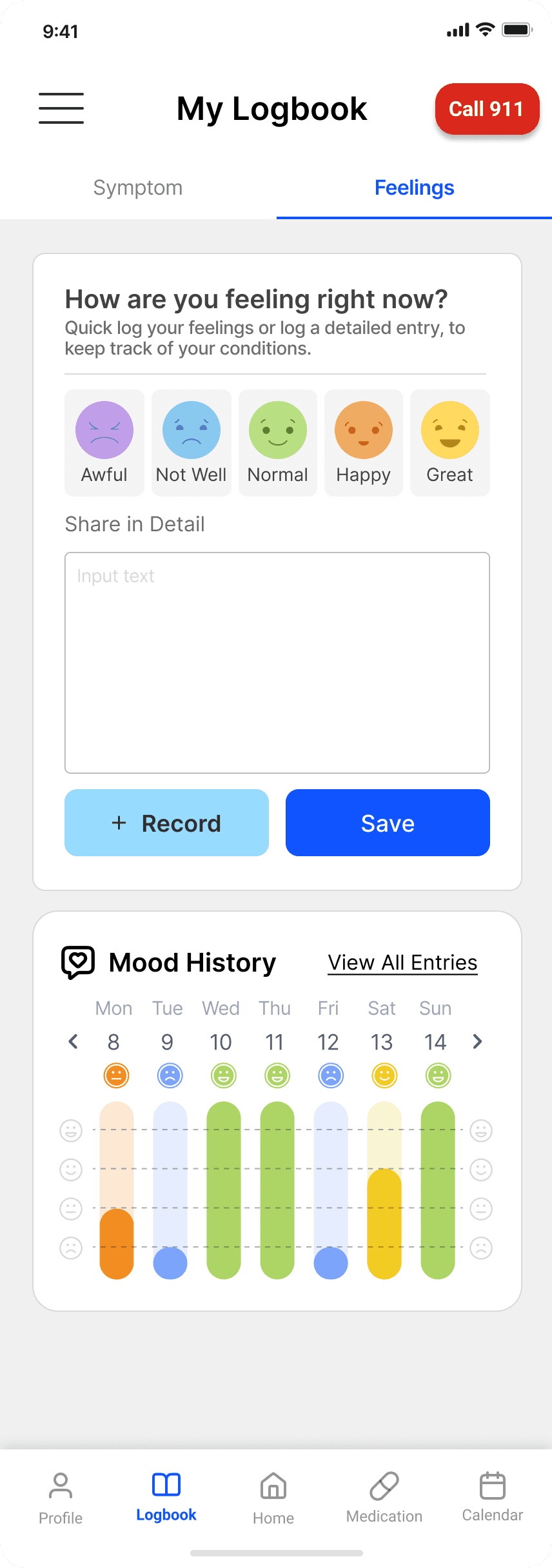
Track symptoms and feelings patterns and share real-time updates with caregivers.
It all started with talking to who matters most
Research
Communication is tight, but information is scattered.
Previous research focused on clinical usability. We shifted to understanding how patients and caregivers actually manage health information at home.
Our two goals for our 8 structured interviews included:
Explore how patients and caregivers currently communicate with each other
Identify difficulties with caregiving, medication management, and tracking medical records.
Interviews revealed that users relied heavily on messaging apps and phone calls to communicate their health status. In addition, other large patterns emerged through our analysis:
1
Caregivers need centralized information shared across all family members.
2
Patients want to track their own health while involving caregivers selectively.
3
Gaps in medical history access delay critical decisions.
⚠️ Scoping challenges
The client wanted us to redesign the entire app, inlcuding multiple user flows, data privacy considerations, and medical compliance, with limited time and a student team.
✅ Our approach
Through stakeholder discussions and advisor guidance, we scoped to patient-caregiver communication as our core focus, ensuring we could deliver a high-quality MVP rather than surface-level updates across the entire platform.
Ideation
How might we improve the communication experience?
We saw the need for new solutions to fully fulfill user needs. We identified 3 main design challenges as goals based on our research insights.
The MoSCoW prioritization method led us to 3 proposed features, which received positive feedback from the client and led to moving forward with the first two features.
While the third feature was beyond scope, the client expressed interest in exploring it in future iterations.
Design
I fleshed out the core navigation screens and prototyped one main feature.
We approached the solutions top-down, and to ensure that the ERbuddy team could implement our designs in the future by creating a new information architecture and task flows to clearly identify all screens involved.
We sketched collaboratively to prioritize which flows to build, then I designed the core navigation screens at mid-fidelity for testing.
By focusing on a minimum viable product, we could gather feedback early and iterate efficiently.
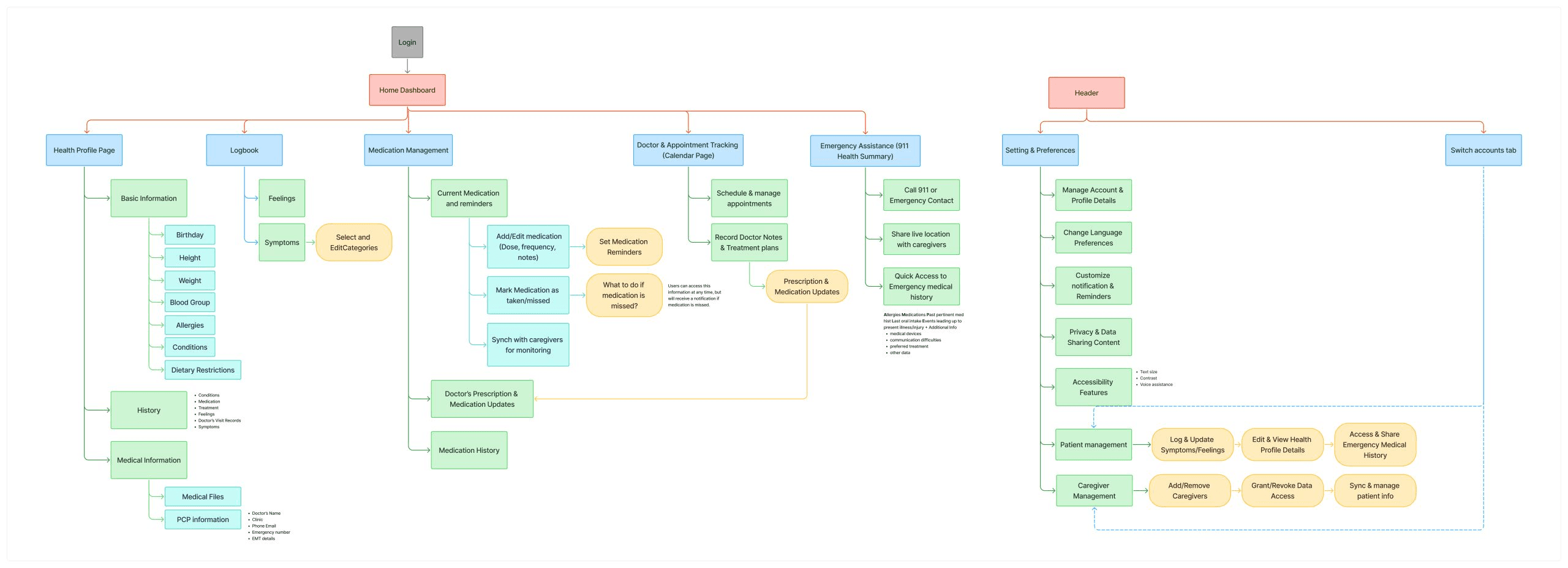
Overarching information architecture of the new ERbuddy app
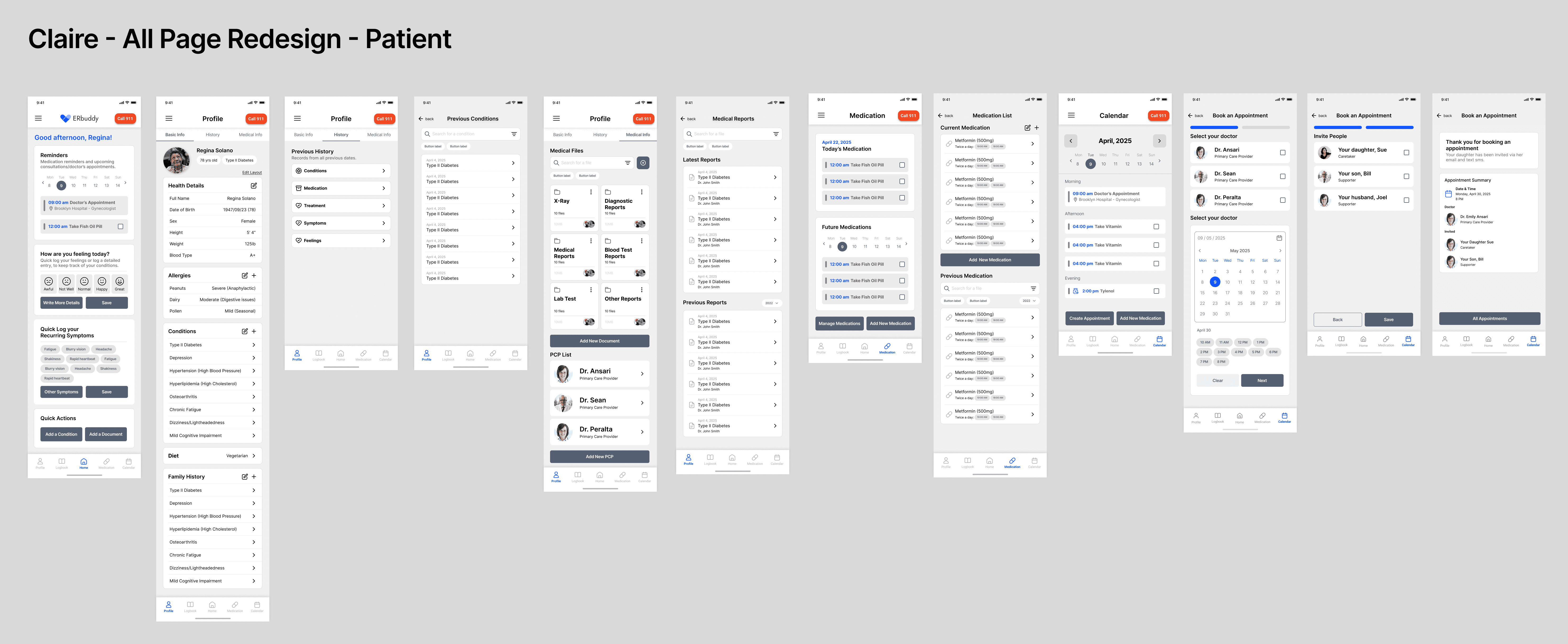
Patient overall navigation and all pages within profile, medication, and calendar
Testing
Testing revealed that role-switching views lacked clarity to caregivers
I conducted 3 out of 7 moderated usability tests at mid-fidelity to validate our approach before investing in design refinement.
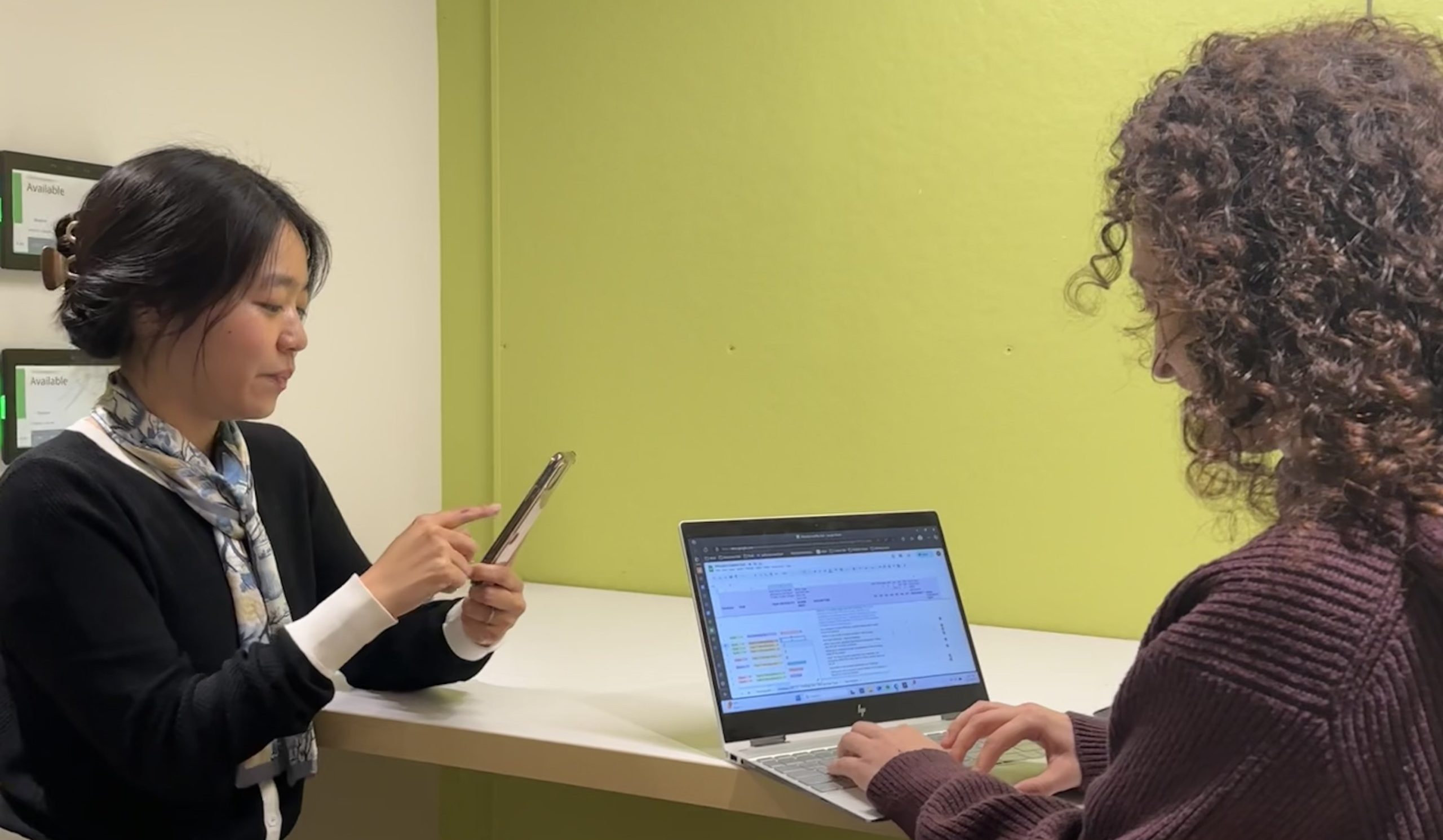
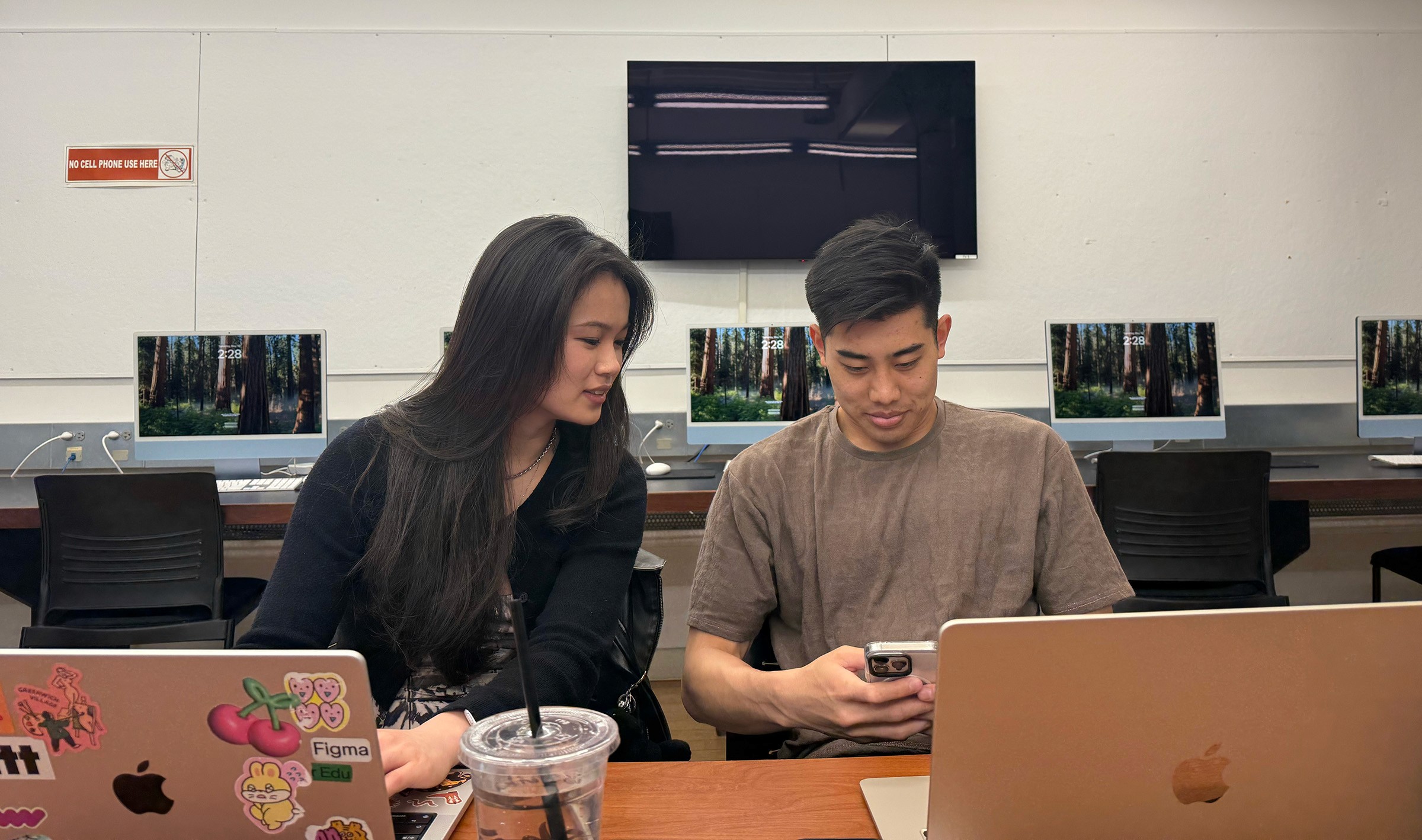
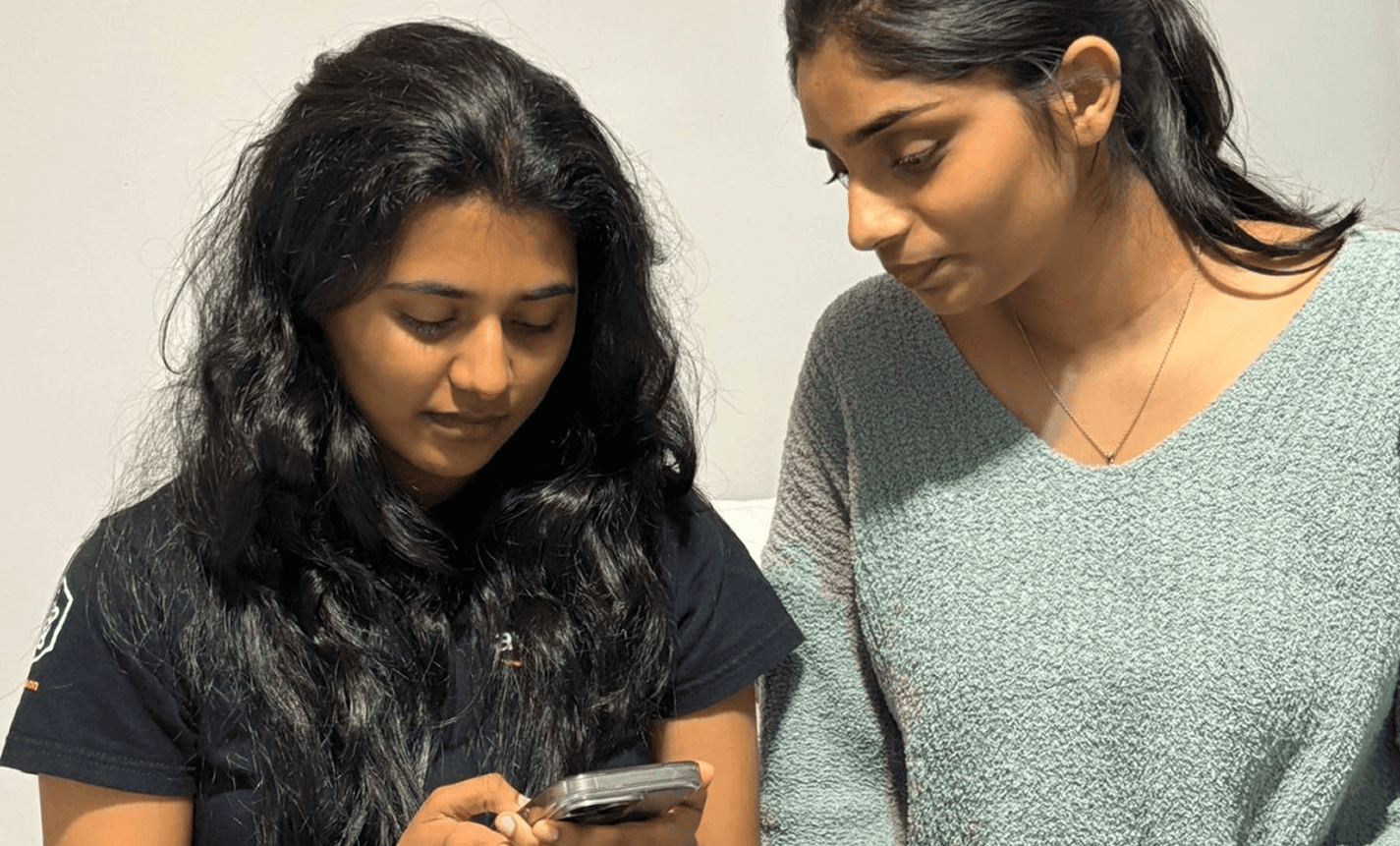
Usability testing sessions done on mobile, facilitated by Karla (left), Claire/me (middle), and Sakshi (right)
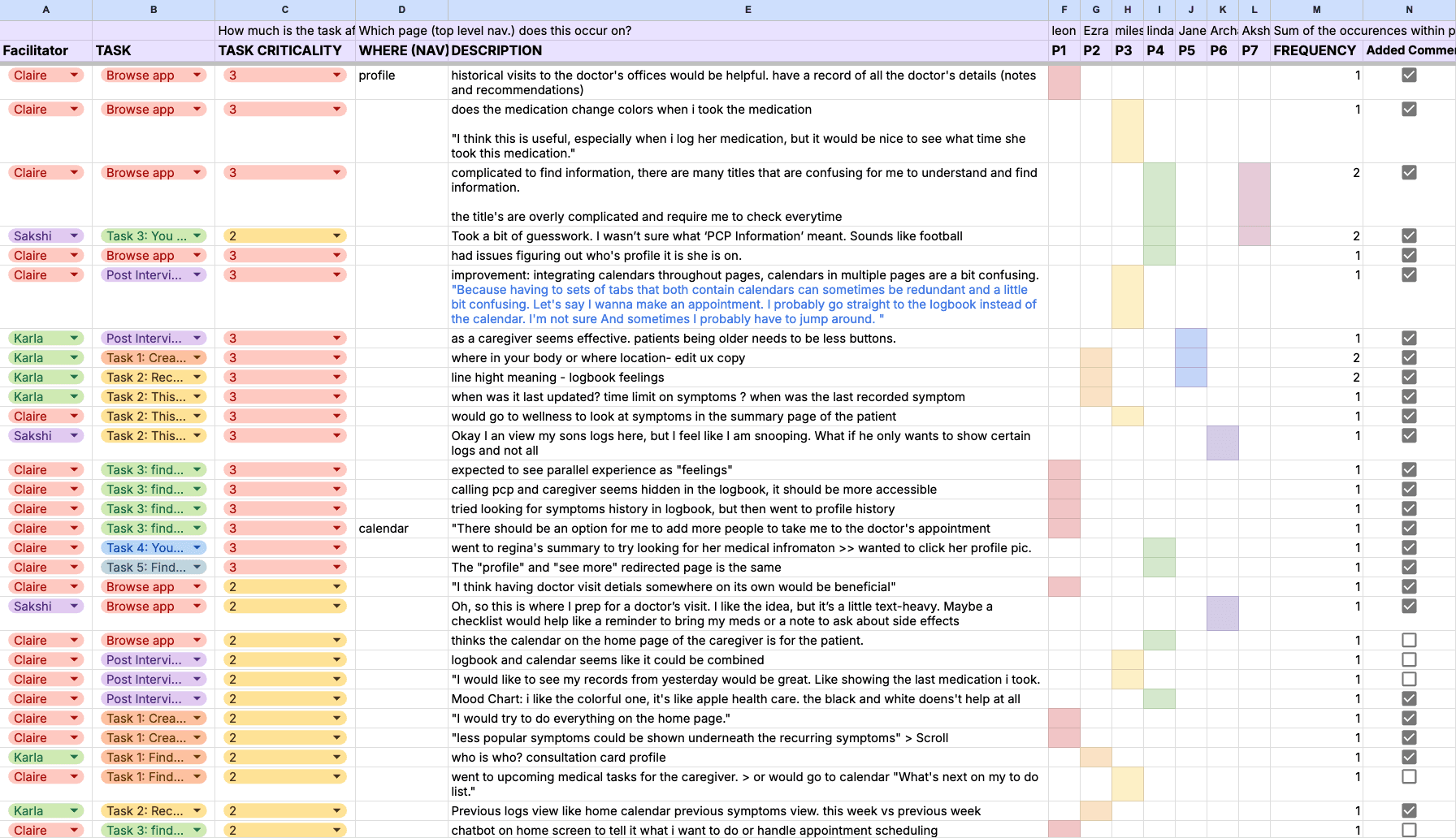
Recorded findings consolidated in a rainbow sheet
Through task-based scenarios and follow-up interviews, we identified 5 critical usability issues:
Caregiver view lacked a clear separation between patient and personal information
Symptom and feelings logging had inconsistent patterns
Medication logging lacks flexibility
Limited account switching flows disrupt workflow



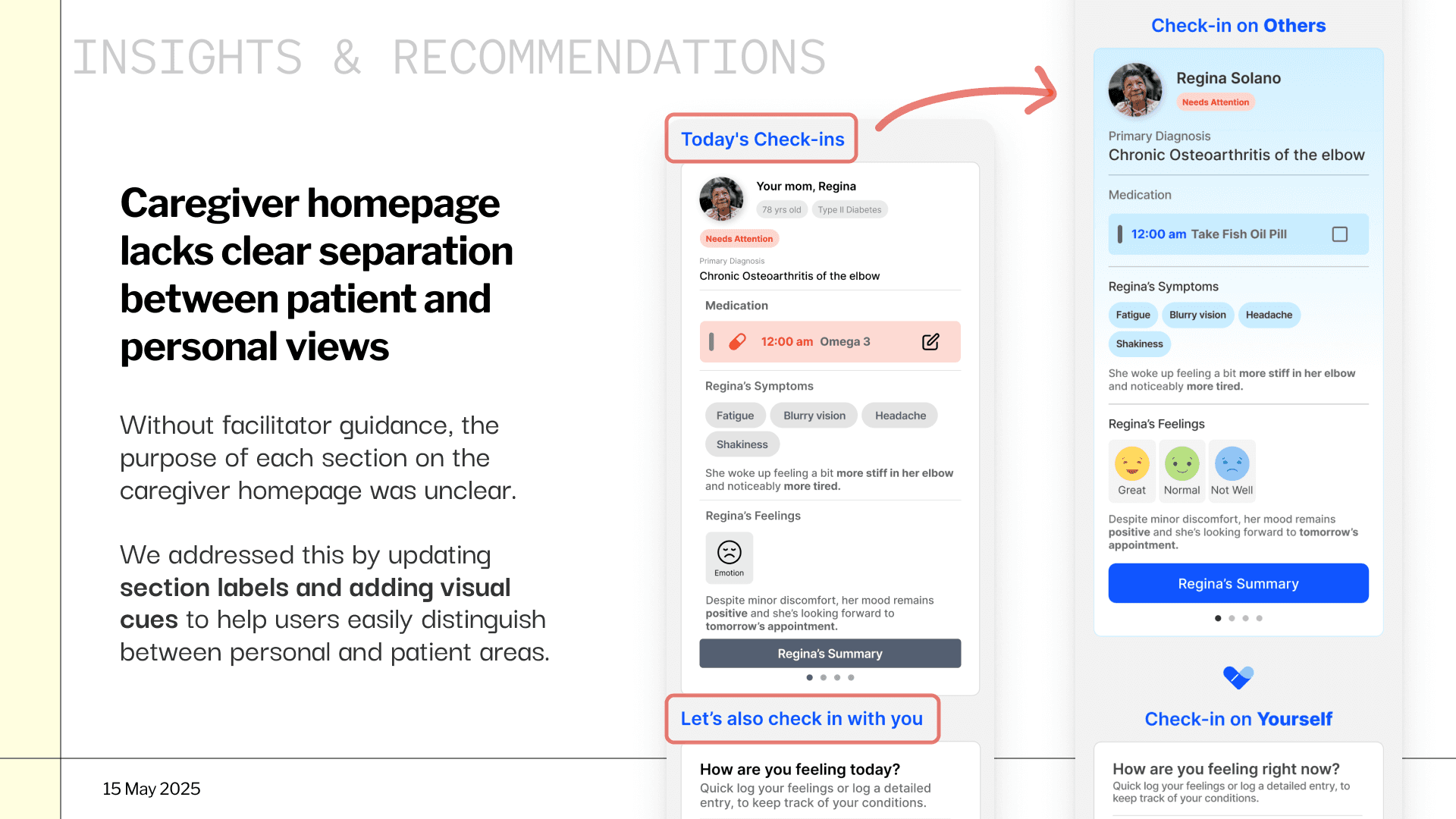
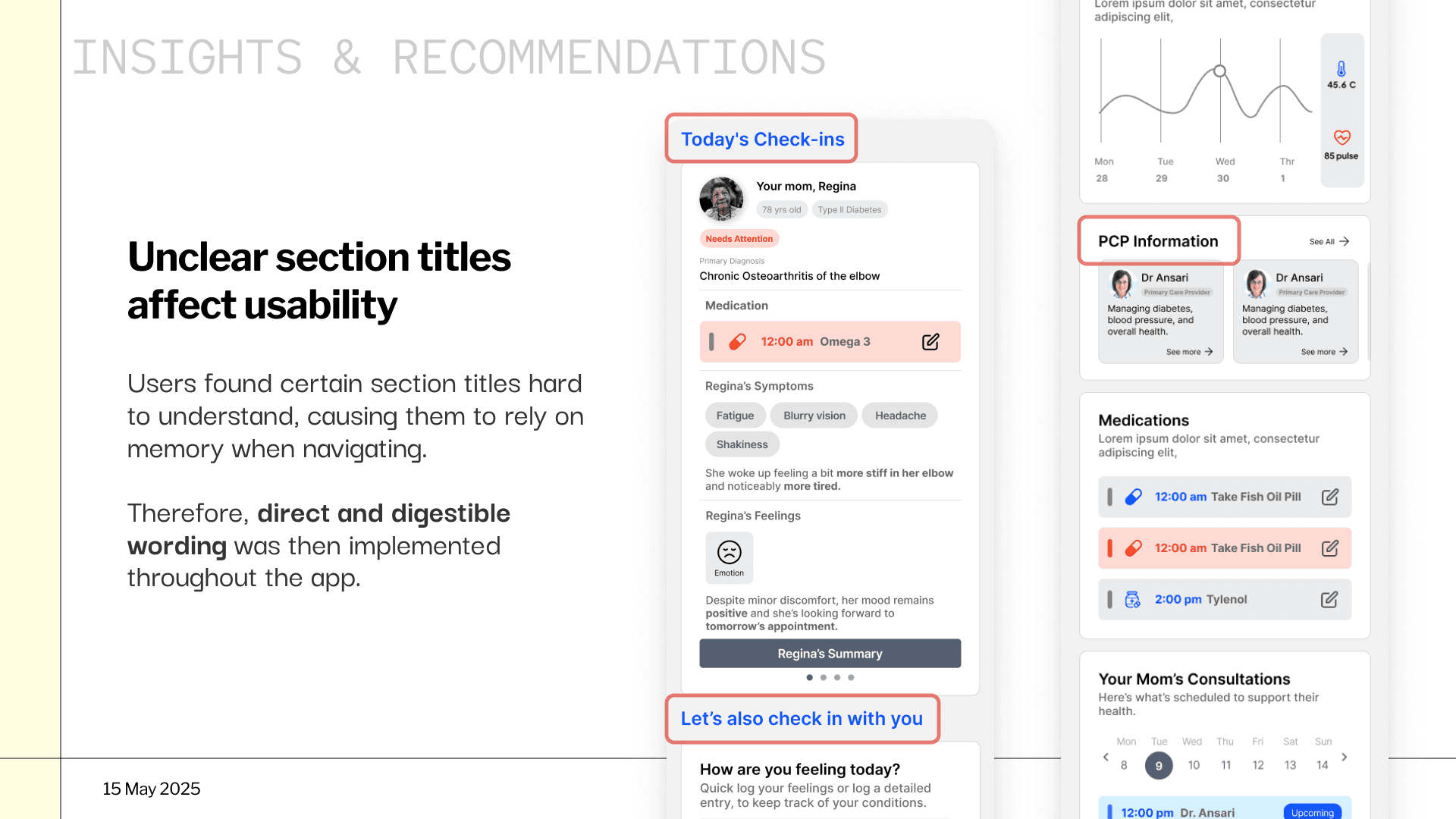
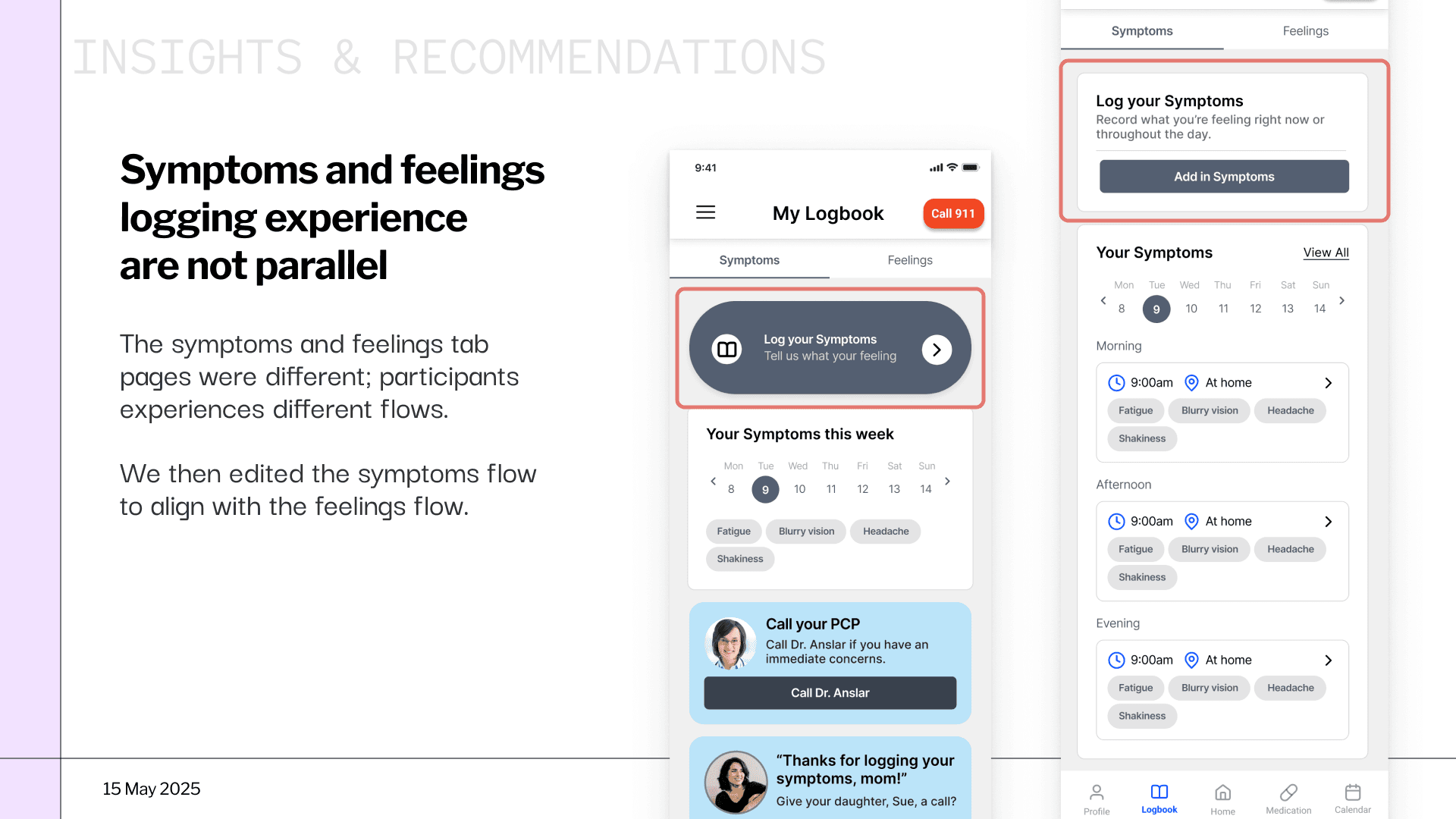
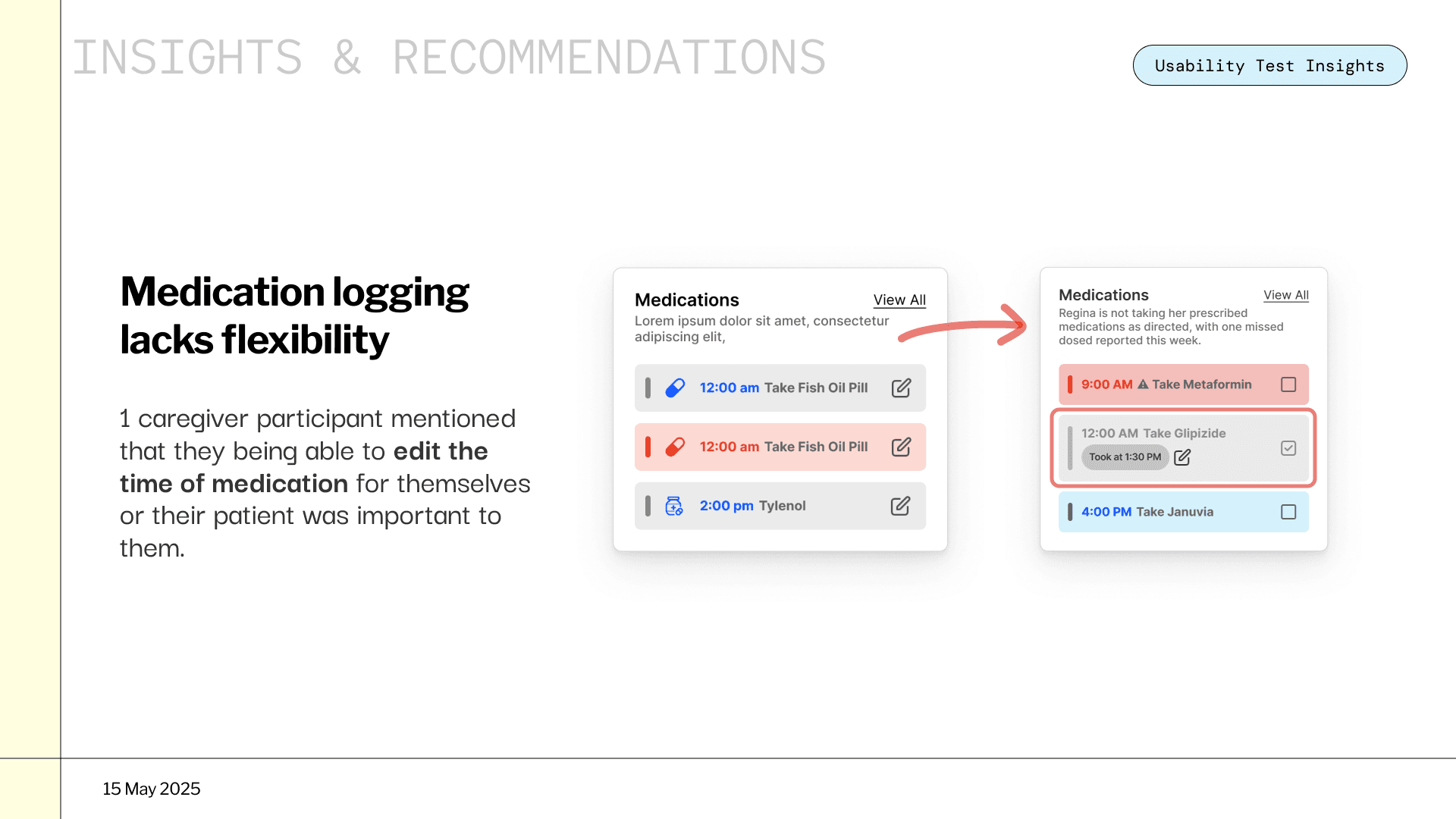
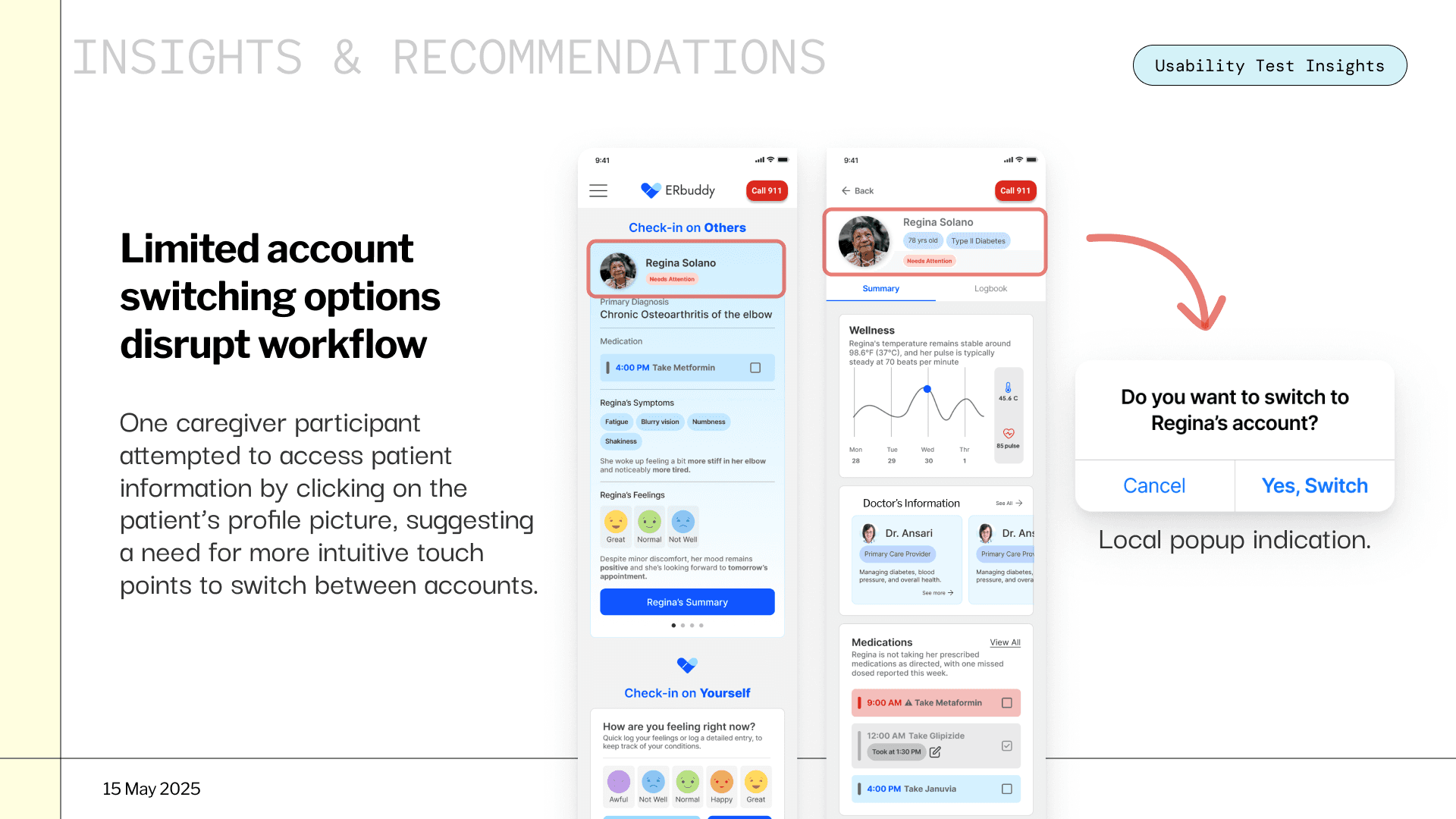
Usability test insights presented during final client presentaion
Based on these findings, we redesigned the caregiver homepage's visual hierarchy and adjusted interaction triggers for the role-switching feature.
Bringing us to the final designs of the 2 newly introduced features
Feature #1
Centralized information for multi-roled caregivers
Caregivers were managing both their own health and their patients', but didn't have a practical and centralized way of governing both. So, we introduced role-switching that let caregivers:
🌟 My focus
Translating our IA into navigation
Establishing the component library foundation
Designing the appointment booking experience
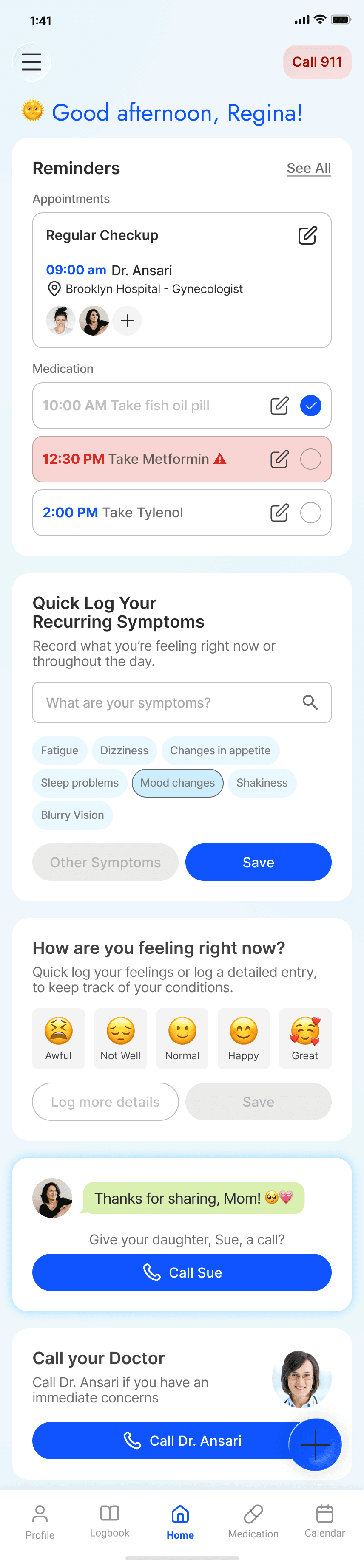
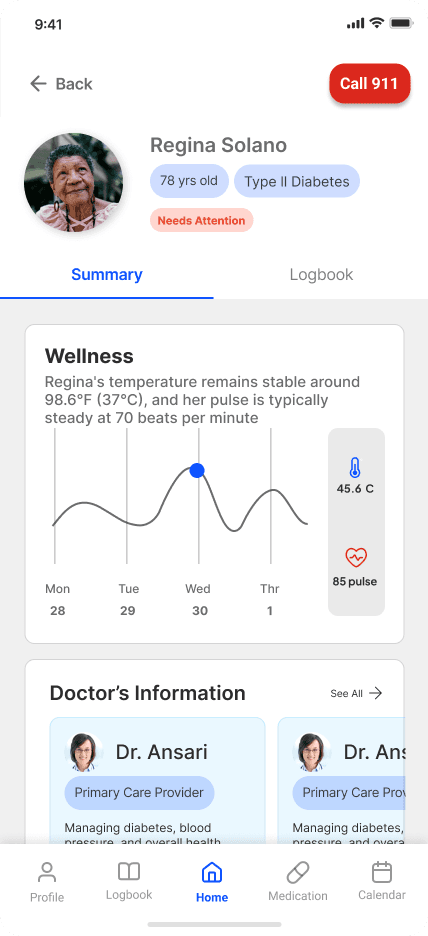
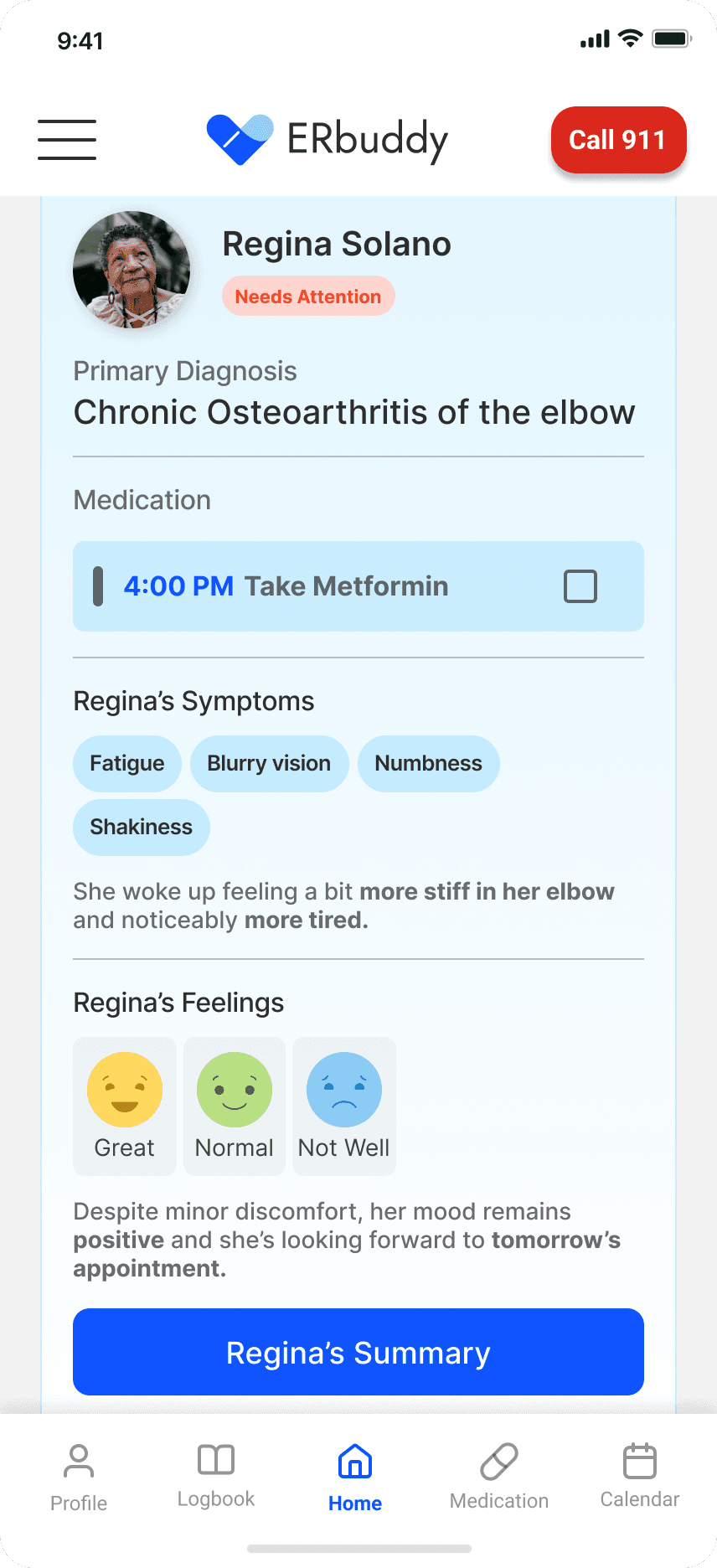
Caregivers manage both their patients' health and their own. We brought patient status summaries onto the caregiver homepage so they could monitor both without switching views.
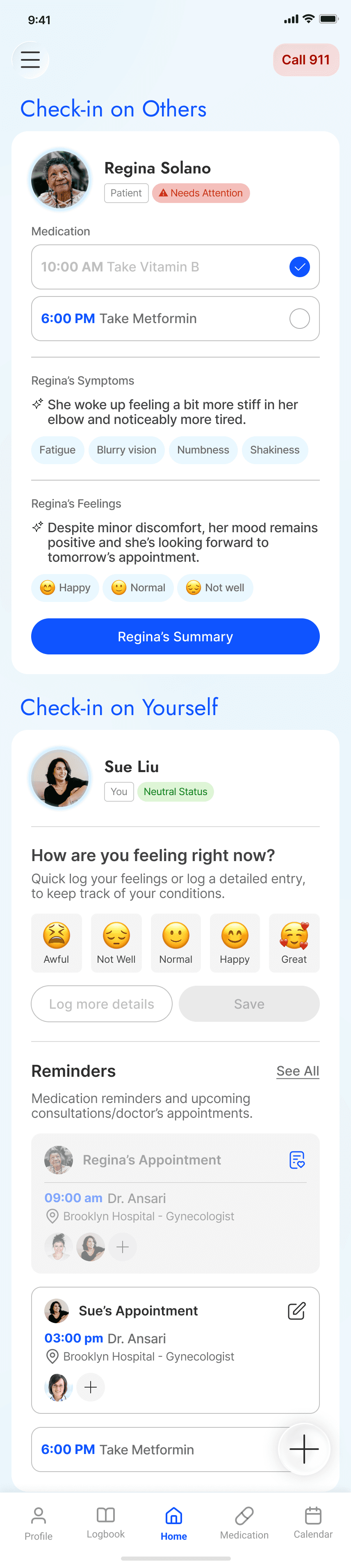
Caregiver account-switching flow
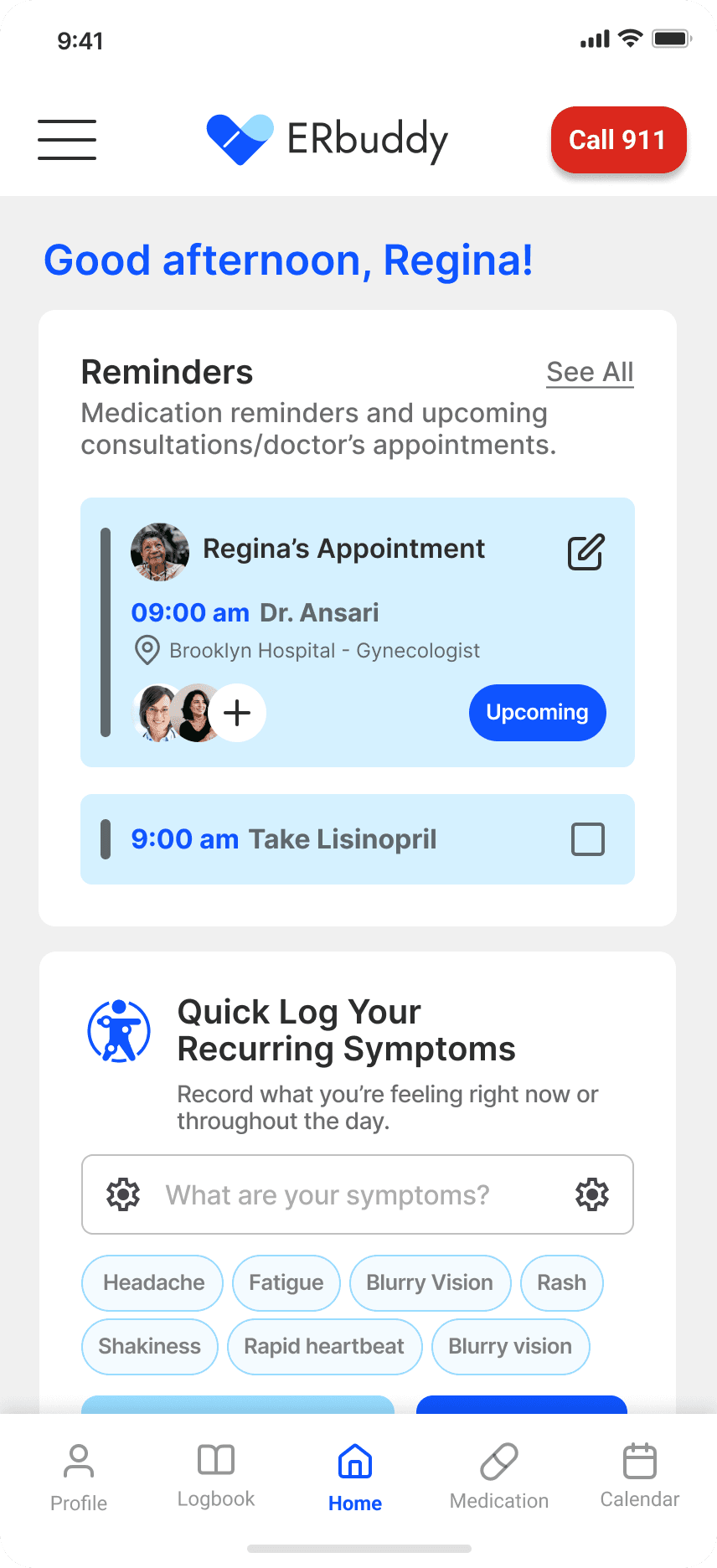

Feature #2
Symptoms and feelings logbook
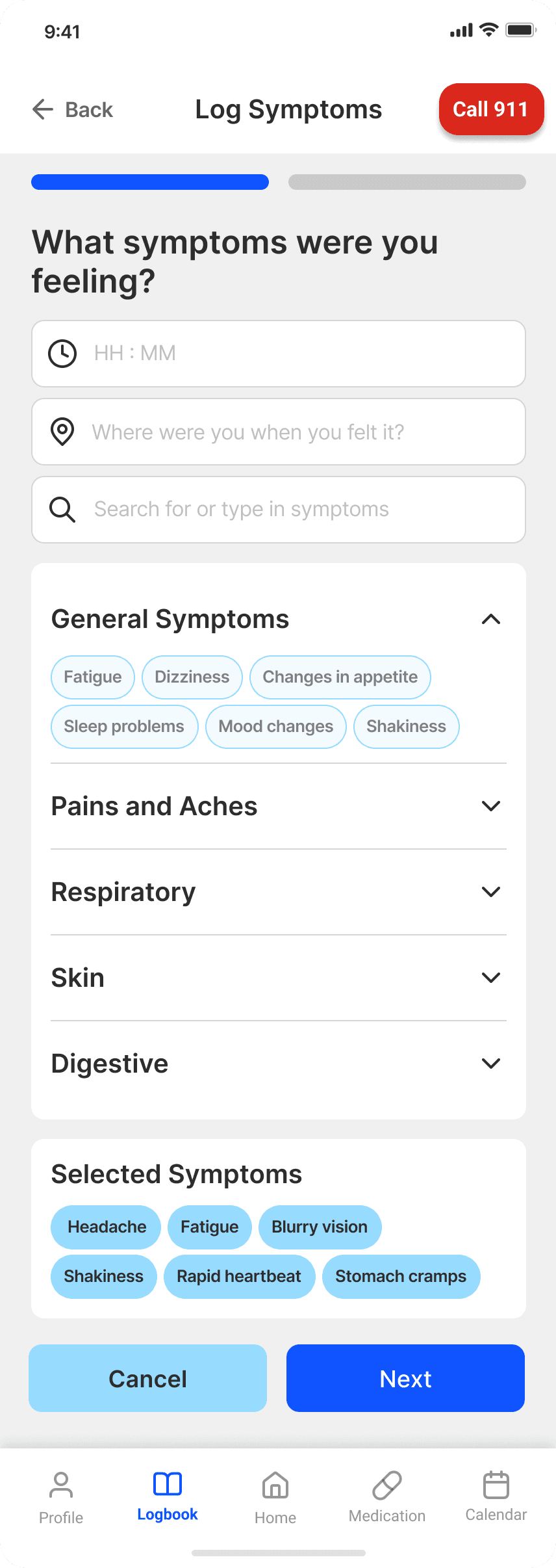
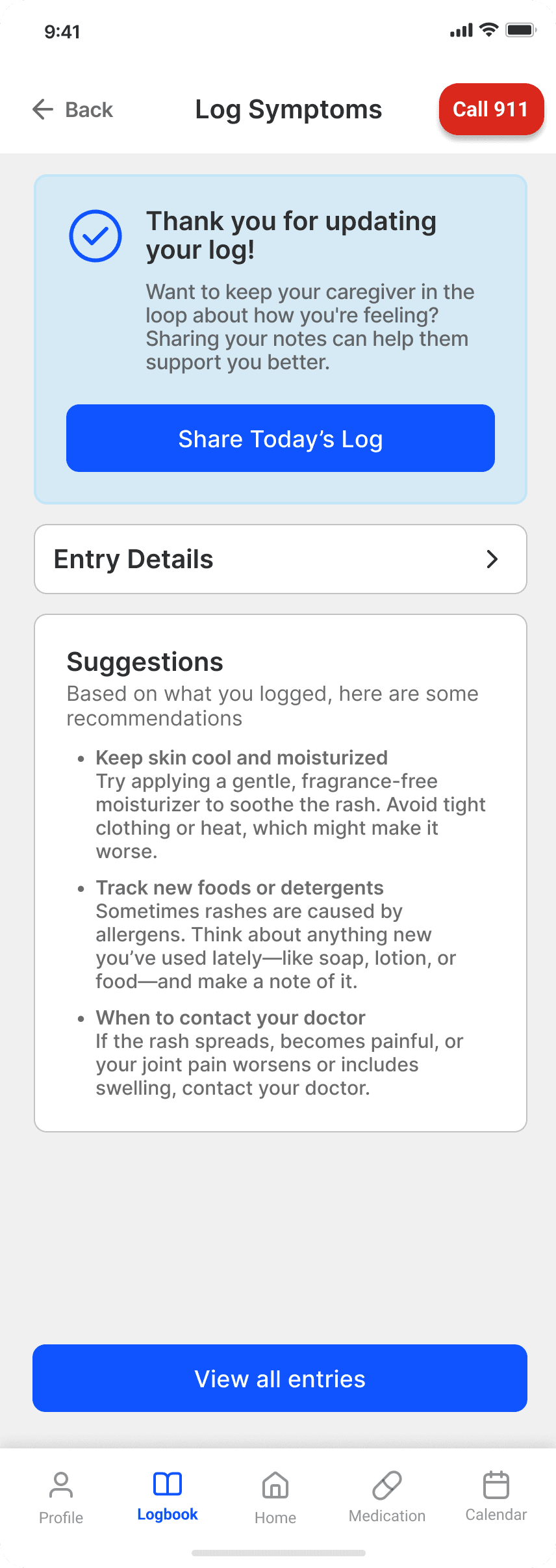
Caregivers struggled to understand what patients were experiencing day-to-day, making it hard to provide appropriate support or communicate with doctors. We designed a logbook that captures both:
🌟 My focus
Designing the symptoms logging flow
Prototyping functionality
Impact
Both features are under development! 🎉
Looking into the future, we defined some expected outcomes for the ERbuddy app:
Increase success rate for all users
1
Ensure 90% of senior users can successfully navigate to their medical history without external assistance
Lower medical error rates
2
Reduce the frequency of 'missed dose' errors through high-visibility, persistent notification patterns.
Improve caregiver satisfaction
3
Help caregivers feel equipped, not overwhelmed. Could measure confidence via Likert scale.
During our final presentation, ERbuddy's founders Ashish and Gurmeet shared their excitement about the direction we'd taken.
"We will most certainly use your insights and hi-fidelity screens to enhance ERbuddy’s Care Managment Platform this summer." – Ashish, ERbuddy Founder
"Your design team really did a wonderful job with your thorough research capturing the needs and gaps." – Gurmeet, ERbuddy Founder
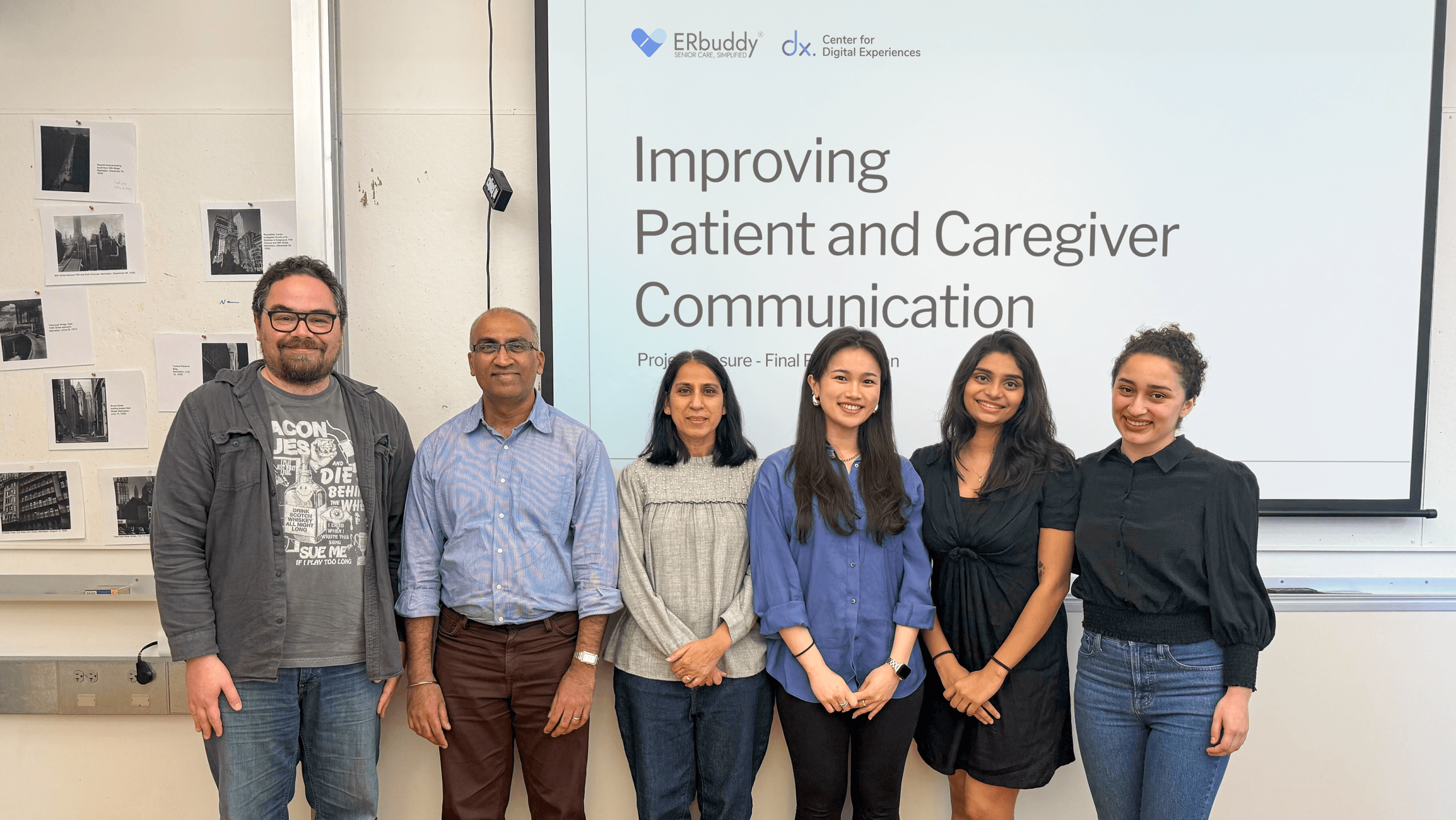
From left to right: Our professor, Josh; Our Clients, Ashish and Gurmeet; Claire; Sakshi; Karla
While the updated app hasn't launched yet, the team has begun implementing our designs into their Care Management Platform.
Learnings
I learned that…
Documentation matters
1
Complex projects require meticulous documentation, not just research insights, but the reasoning behind design decisions at every stage. This became critical in our rounds of improvement and during handoff.
Avoid scope creep from the start!
2
Defining scope under tight timelines is time-consuming and requires constant communication, but it's worth the investment. Clear boundaries early prevent scope creep later.
As a personal reflection, this was probably one of the most challenging projects in my career. Healthcare is complex, and the problems caregivers face are both common and difficult to solve. But that's exactly what made it rewarding.
About the Team
Big thanks to the team!
Working with Karla and Sakshi made this project what it is.
Karla brought empathy and research rigor to every conversation
Sakshi's healthcare knowledge and systems thinking kept our designs grounded and scalable
Through countless sprints and long brainstorming sessions, we tackled ambiguity together and came out with something we're all proud of.
Special thanks to our instructor/advisor, Josh, for providing great guidance and advice!