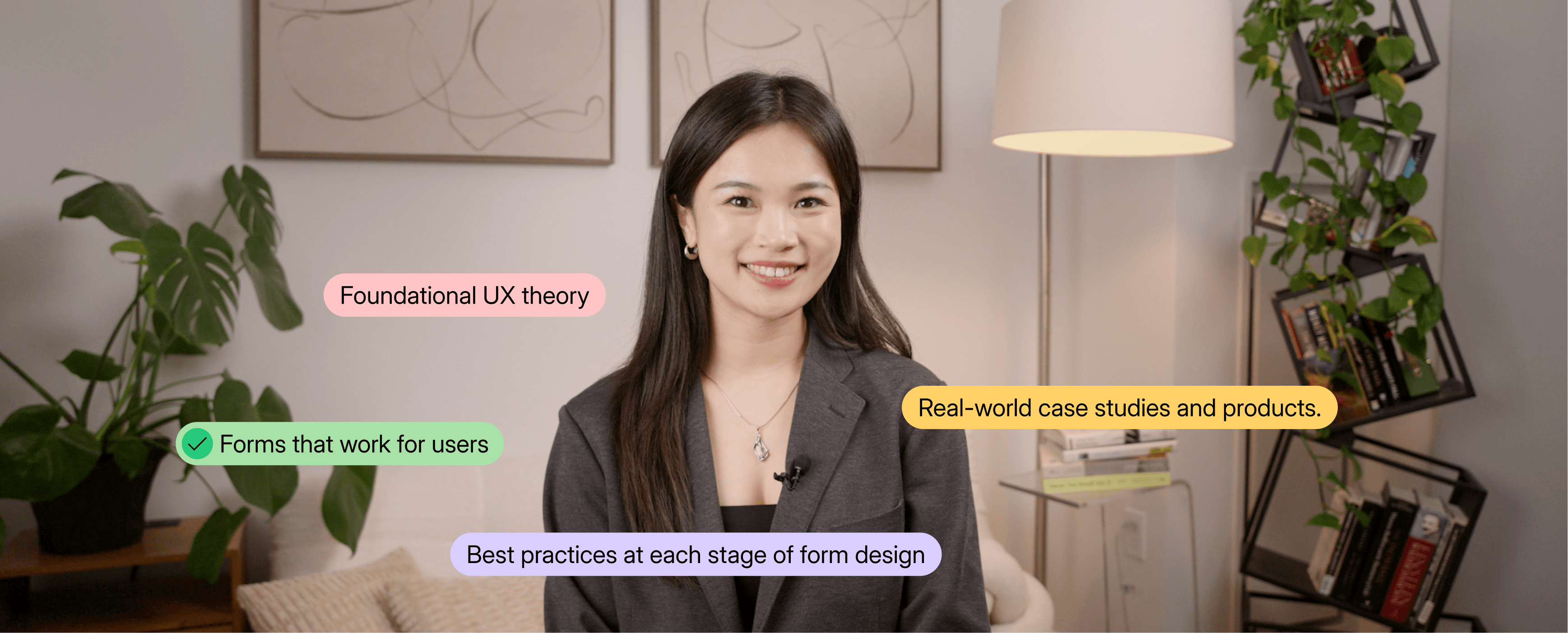
Teaching Forms Systematically: How I Created a Self-Paced Course on Web Form Design
Instructional Design
Interaction Design
UI/UX Design
Duration
6 months, Spring 2026
Team
1 Instructor (me)
1 Instructional Designer
1 UX Writer
Video Team
Design Team
Company

What I did
Qualitative research (interviews)
Secondary research
Course structure design
Instructional scripting
Iterative content refinement
Problem
Taking on a new challenge: becoming an instructor
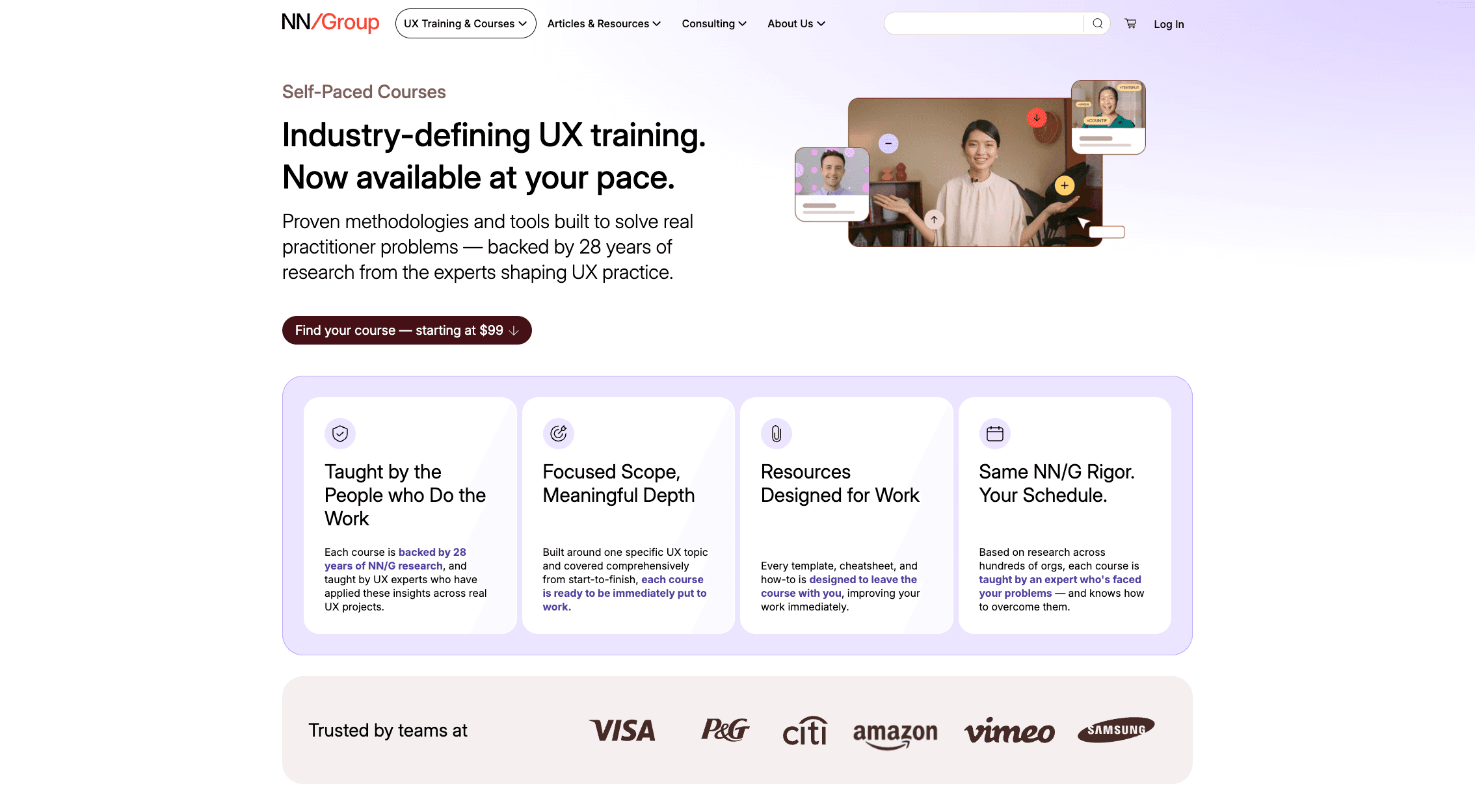
NN/G Self-Paced Courses page
Here's what surprised me during the research phase: I thought designers struggled with visual choices (Should a form be single page or multi? Where do labels and placeholder text go?).
But when I talked to practitioners, they told me the real challenge was different. They struggled to explain their form decisions to developers, product managers, or stakeholders.
They lacked a shared language and framework for reasoning through form design choices.
That insight became the foundation for everything I created. This wasn't going to be a course about form aesthetics or trends. It was going to be a course about systematic thinking, giving designers a framework they could use to make decisions and communicate the reasoning behind those decisions to anyone on their team.
Research & Strategy
Understanding what designers actually struggle with: communication, not aesthetics
I started by conducting targeted interviews with UX practitioners to validate what I thought I knew. I asked them: What's hard about designing forms? What trips you up? What do you wish you understood better?
The answers pointed to a communication gap. Designers were making decisions in isolation, without a clear way to involve developers early or explain trade-offs to stakeholders. It wasn't a knowledge problem; it was a language problem.
From there, I did deeper research through design forums, case studies, and secondary sources to understand the full scope of form design challenges. I synthesized what I learned into a clear framework to teach learners: Explain → Demonstrate → Test.
1
Explain foundational concepts
2
Demonstrate with examples
3
Test learner understanding
This wasn't just my framework; it's a well-established instructional design approach designed by the NN/G instructional designers. But it was the right structure for teaching designers how to think about forms.
I decided the course would be organized around five key stages of form design:
Plan
Write
Design
Test
Analyze.
Each stage would connect to real stakeholder conversations and decision-making moments. The course wasn't teaching designers to memorize best practices. It was teaching them to reason through problems using a systematic approach that they could defend to anyone.
Instructional Design Process
Structuring, scripting, and refining 38 video lessons
Planning & Structure
Before I wrote a single script, I spent time understanding who would take this course and what they needed to actually do with the knowledge. I went through four iterations of the course outline, each time refining how concepts built on each other, how theory connected to practice, and where examples should live.
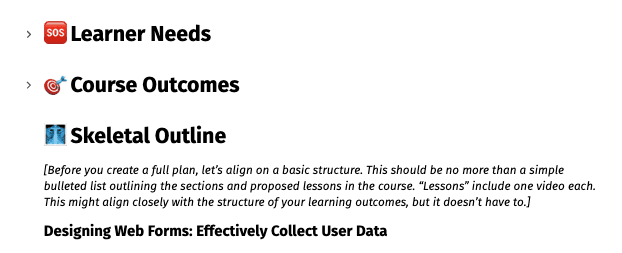
Google Doc where I listed all learner needs, course outcomes, and structured the course outline.
I defined the course structure around a central question: How do you make informed form design decisions and explain your reasoning to collaborators? Everything flowed from that and ending up with 6 sections for the overall course outline:
0
The Building Blocks of a Good Web Form
1
Deciding What to Ask (and What Not to Ask)
2
Asking Clean, Clear Form Questions
3
Web Form Interaction Design: Controls and Errors
4
Designing the Flow through Your Form
5
Finalizing, Delivering, and Evaluating Your Forms
Note
Due to confidentiality agreements and the proprietary nature of NN/G's paid offerings, I'm unable to share specific course content or detailed curriculum materials. However, I can speak to the instructional approach and process that shaped the work.
Scripting Philosophy: Show the HOW
Once the structure was locked, I started scripting 38 instructional video lessons. This is where my instructional design philosophy came to life.

Preview of section 3's script
I learned early on that explaining what to do wasn't enough. I needed to show designers how I would approach a problem as someone with deep expertise in forms.
For example, when teaching how to select the right input controls for a form, I didn't just explain the theory. I walked through a real medical intake form scenario, showing step-by-step how I'd make decisions and why.
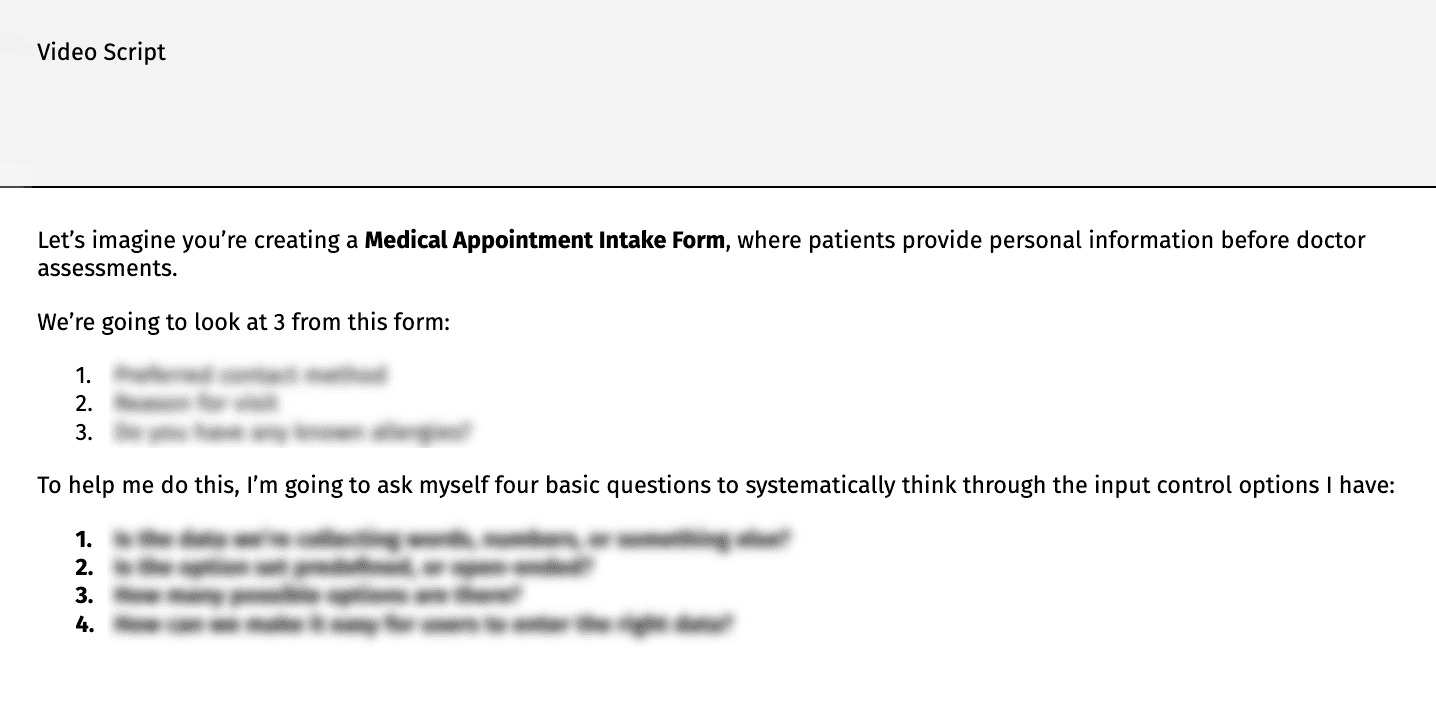
Medical intake form example within the course script
The goal wasn't to teach them one specific form; it was to teach them a way of thinking they could apply to any form.
This "explain and demonstrate" approach required deep research into each topic, finding real examples, understanding edge cases, and articulating the reasoning behind best practices. I wanted designers to understand not just what forms do, but why certain decisions matter and how to explain that to their teams.
Iteration & Collaboration
I worked closely with Tanner, NN/G's instructional designer, who served as my reviewer and guide. Over multiple rounds of refinement, Tanner provided approximately 800 comments on my scripts. These weren't just small tweaks. They were substantive feedback pushing me to be clearer, more practical, more grounded in real design scenarios.
The feedback loop was intense. Tanner would ask: "Why should a designer care about this?" or "How would you actually do this on a real project?" Those questions forced me to move beyond theory into the reasoning that makes a decision stick.
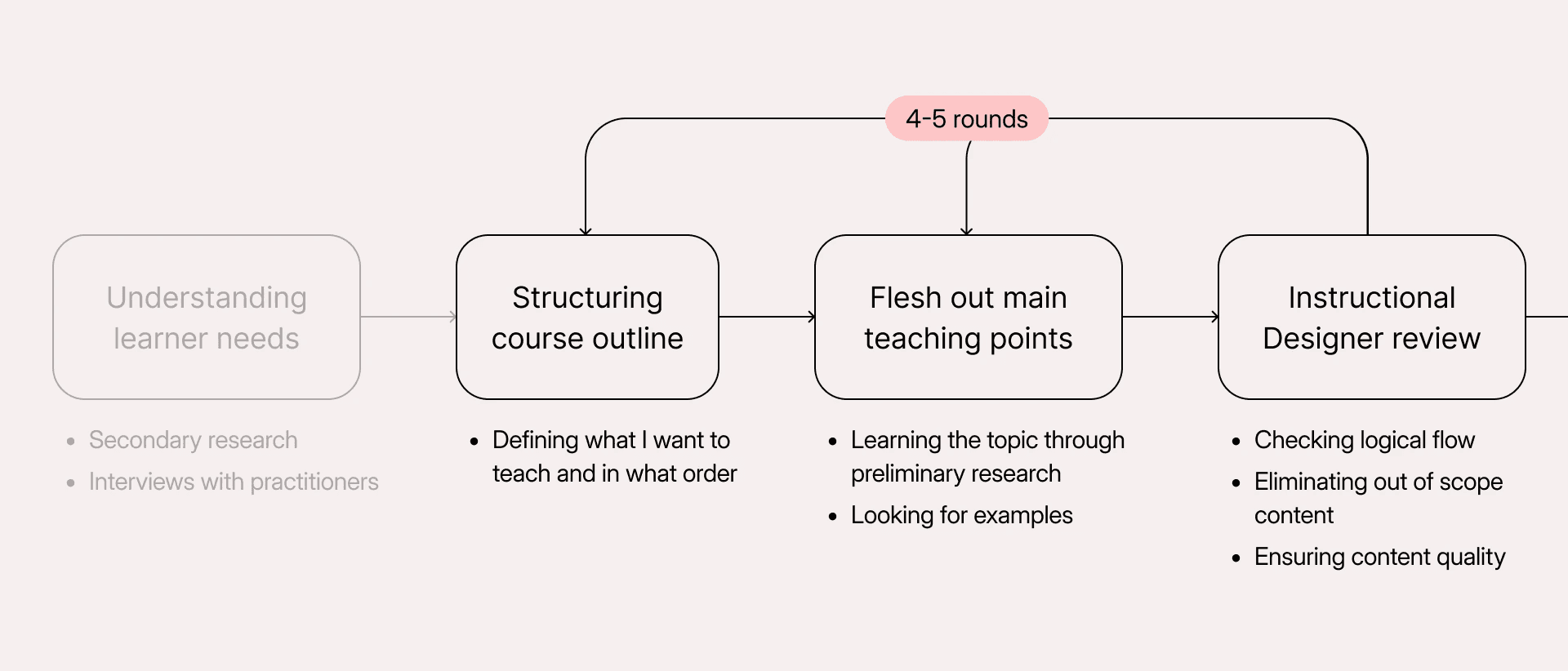
Process flow of the iteration process
Production & Prior Experience
One thing that accelerated this work: I've been creating instructional content before. I have a background in commercial photography and videography, and I spent time at my previous company teaching people about 3D printing on camera, via YouTube. I understood on-camera presence, pacing, how to write for the ear, not the eye, how to work with teleprompters and lighting equipment.
This wasn't my first time figuring out how to communicate complex concepts in video format. I could focus entirely on what I was teaching rather than learning how to film at the same time.
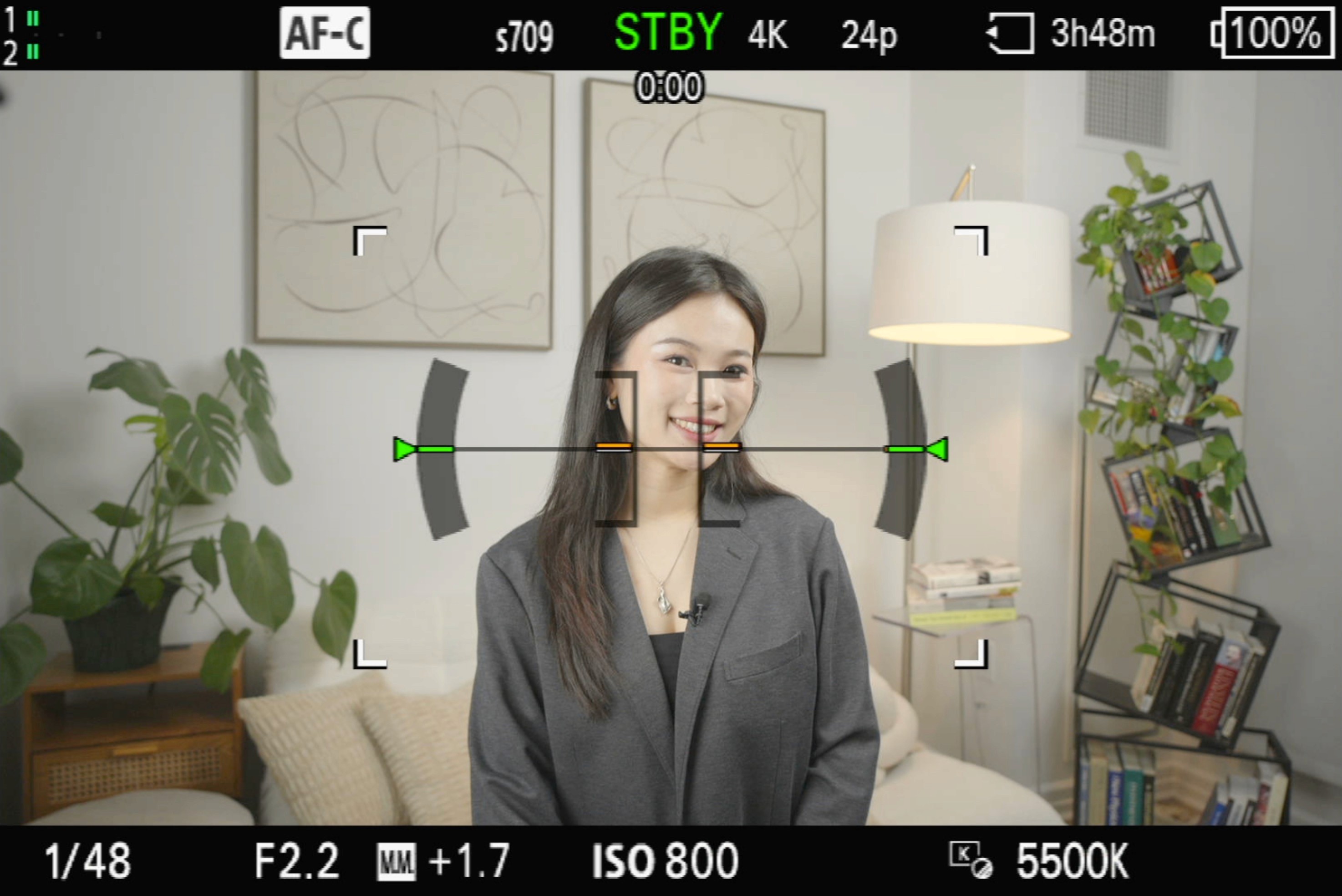
Camera view of me during filming
The production setup itself was a constraint worth noting. NN/g shipped a full filming kit to my home: professional lighting, camera, teleprompter, audio equipment, and I had to set it all up in my boyfriend’s living room, learn the technical workflow, and then film 38 videos solo.
For many speakers, this would be overwhelming. But because I'd worked with professional video equipment before, I could focus on content quality and on-camera delivery rather than troubleshooting gear. The video team handled post-production; I handled content and scripting.

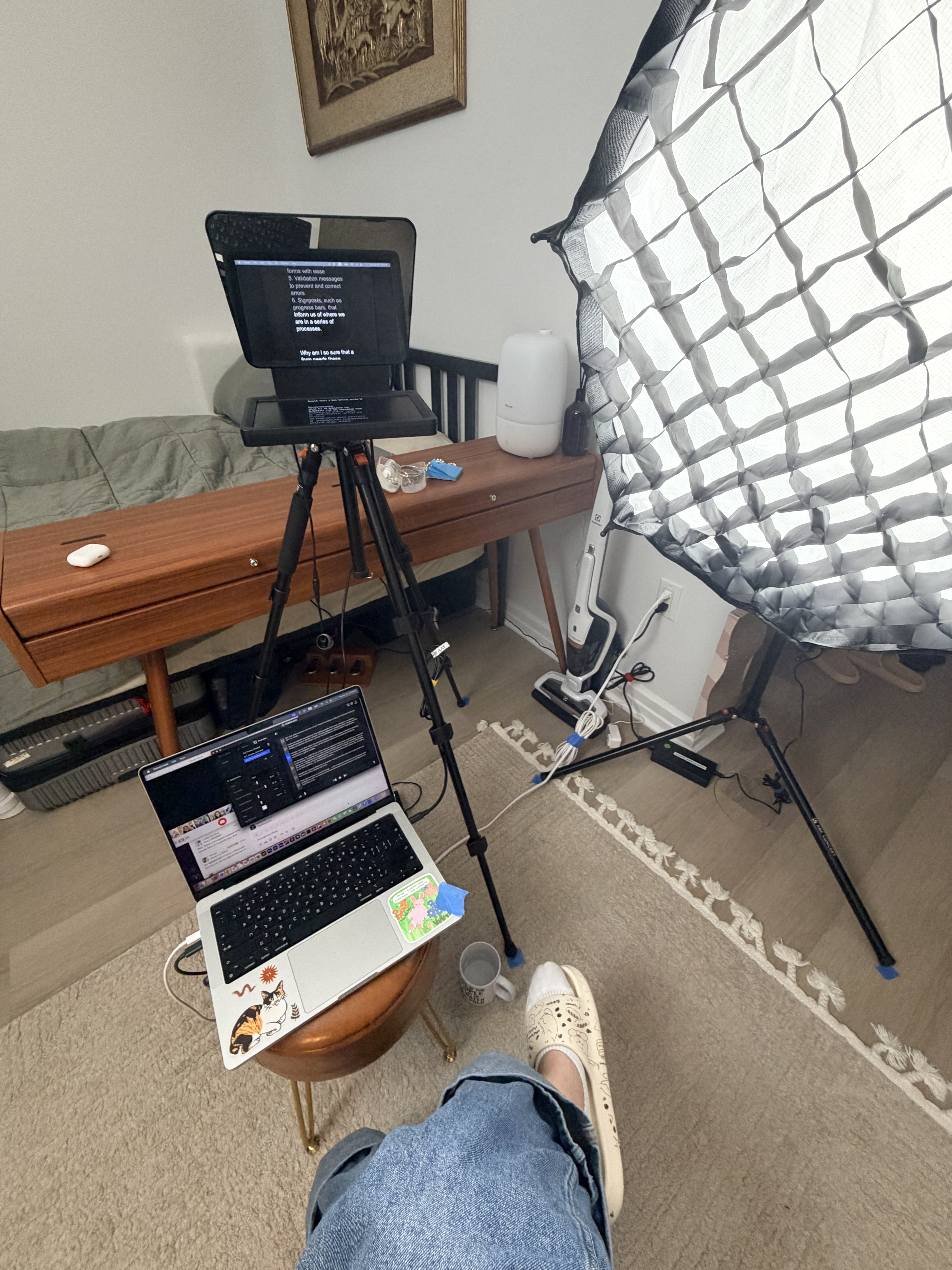

Filming kit (left), my view during filming (center), lighting equipment and overall set up (right)
Learnings & Impact
How instructional design shaped my understanding of design
The Real Challenge
Working through this project clarified something fundamental: the biggest gap in form design isn't aesthetic knowledge, it's the lack of a shared framework between designers and the rest of their team. When I talked to practitioners, they weren't asking "Should this field be a text input or a select dropdown?" They were asking "How do I convince my developer that this approach is better?" and "How do I explain this to my product manager?"
By teaching designers to reason systematically through form decisions — understanding who the stakeholders are, what the business needs, what the constraints are, how to measure success — I was giving them language to have those conversations.
My Growth
Creating this course forced me to articulate things I understood intuitively as a designer but had never had to teach. I learned that being an instructor is a form of design in itself: you're designing learning experiences, not just interfaces. You're deciding what to emphasize, what to leave out, how to sequence ideas so they build on each other, where to show real examples so theory becomes tangible.
This project expanded how I think about my role at NN/G. I'm not just supporting the video team's production. I'm helping create the intellectual content that educates the UX community.
Potential Impact
The course launches in late May 2026 with both the production and design team finalizing the lessons.
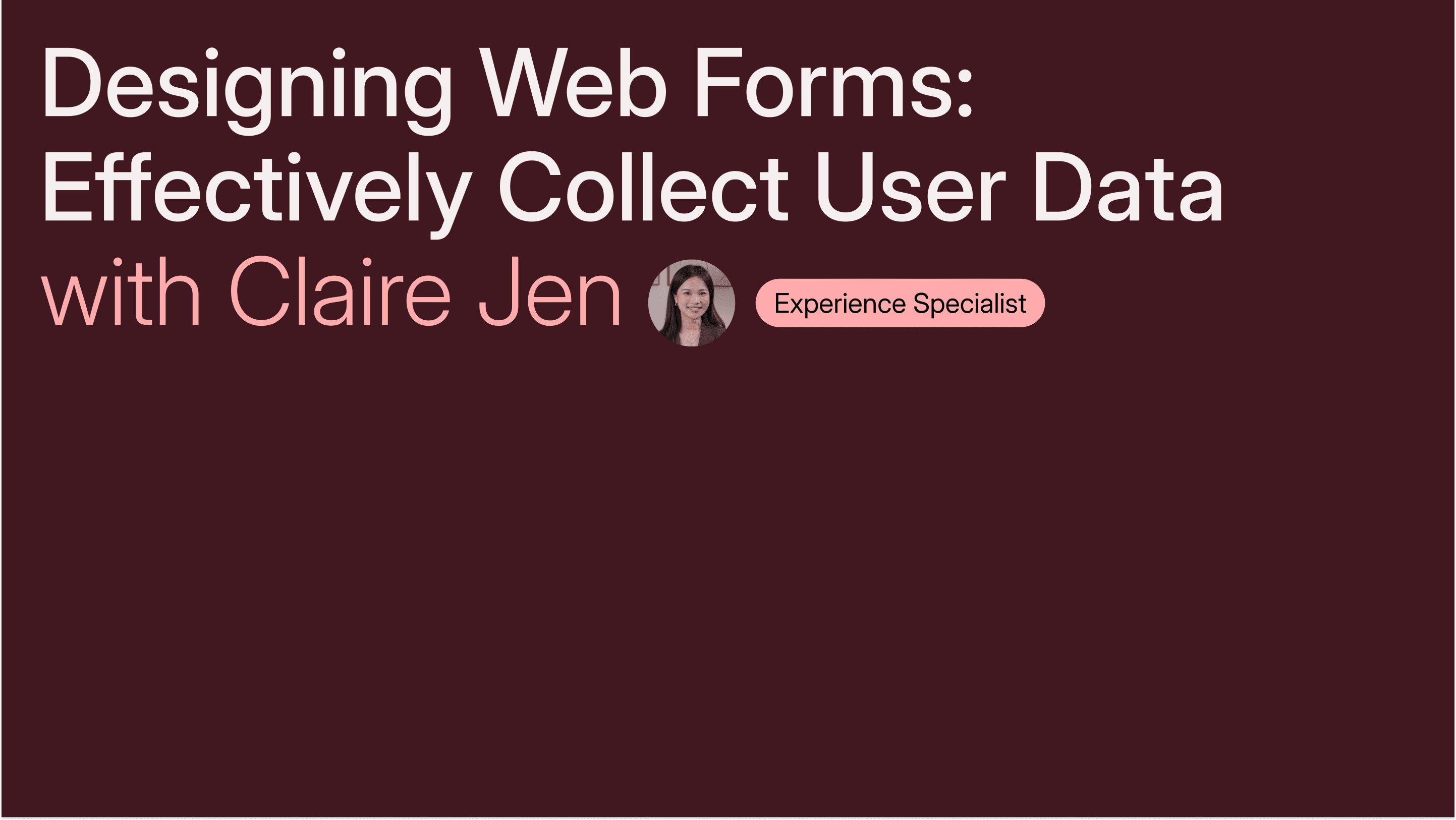
Course title card designed by the design team
The course includes 38 video lessons, 5 hands-on practice activities where learners apply what they've learned, and assessment questions designed to reinforce key concepts.
The learners who complete this course will be able to:
Make informed decisions about form structure, copy, and interaction design
Understand how their form decisions affect different stakeholders
Articulate the reasoning behind their design choices in a way that convinces their team
Apply a systematic framework to form projects of any scale
Even though the course isn't live yet, the intellectual work is done. The content is scripted, refined, and ready for production. I've solved the design problem: How do you teach designers to think systematically about forms?
Final Reflection
Becoming an instructor taught me more about design than I expected. It forced me to get specific about why things matter, not just how to do them. It showed me that the real value in design isn't always the visual: it's the framework you give people to make decisions.
I'm launching this course in late May. I'm excited to see how designers use it, and what they're able to accomplish once they have a shared language for talking about forms with their teams.
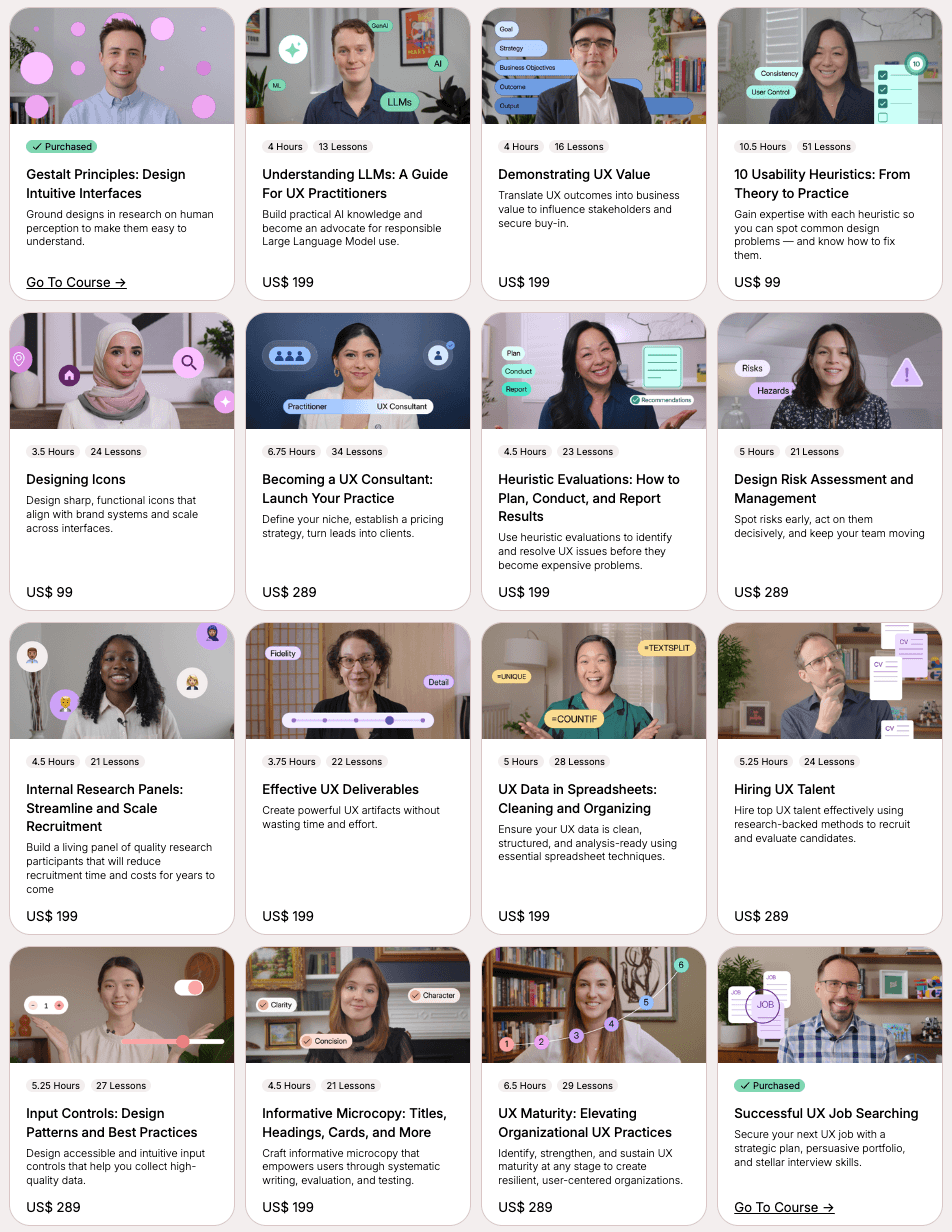
NN/G's Self-Paced course library
About the Team
Couldn’t have done it without guidance from my mentors!
Special thanks to all my mentors: Tanner for being such a patient instructional design expert and reviewer, Huei-Hsin for building a strong foundation and always answering my questions, and Megan for being a supportive mentor and providing in-depth insight on handoff.
And thank you to all the practitioners who helped me along the way, friends and family that supported me, and a special thanks to Leon for lending me his studio to film. I love you all!

Claire Jen (me!)
Design Assistant

Tanner Kohler
Principal Experience Specialist

Huei-Hsin Wang
Senior Experience Specialist

Megan Brown
Experience Specialist
Read more of my case studies

Teaching Forms Systematically: How I Created a Self-Paced Course on Web Form Design
Instructional Design
Interaction Design
UI/UX Design
Duration
6 months, Spring 2026
Team
1 Instructor (me)
1 Instructional Designer
1 UX Writer
Video Team
Design Team
Company
What I did
Qualitative research (interviews)
Secondary research
Course structure design
Instructional scripting
Iterative content refinement
Problem
Taking on a new challenge: becoming an instructor
NN/G Self-Paced Courses page
Here's what surprised me during the research phase: I thought designers struggled with visual choices (Should a form be single page or multi? Where do labels and placeholder text go?).
But when I talked to practitioners, they told me the real challenge was different. They struggled to explain their form decisions to developers, product managers, or stakeholders.
They lacked a shared language and framework for reasoning through form design choices.
That insight became the foundation for everything I created. This wasn't going to be a course about form aesthetics or trends. It was going to be a course about systematic thinking, giving designers a framework they could use to make decisions and communicate the reasoning behind those decisions to anyone on their team.
Research & Strategy
Understanding what designers actually struggle with: communication, not aesthetics
I started by conducting targeted interviews with UX practitioners to validate what I thought I knew. I asked them: What's hard about designing forms? What trips you up? What do you wish you understood better?
The answers pointed to a communication gap. Designers were making decisions in isolation, without a clear way to involve developers early or explain trade-offs to stakeholders. It wasn't a knowledge problem; it was a language problem.
From there, I did deeper research through design forums, case studies, and secondary sources to understand the full scope of form design challenges. I synthesized what I learned into a clear framework to teach learners: Explain → Demonstrate → Test.
1
Explain foundational concepts
2
Demonstrate with examples
3
Test learner understanding
This wasn't just my framework; it's a well-established instructional design approach designed by the NN/G instructional designers. But it was the right structure for teaching designers how to think about forms.
I decided the course would be organized around five key stages of form design:
Plan
Write
Design
Test
Analyze.
Each stage would connect to real stakeholder conversations and decision-making moments. The course wasn't teaching designers to memorize best practices. It was teaching them to reason through problems using a systematic approach that they could defend to anyone.
Instructional Design Process
Structuring, scripting, and refining 38 video lessons
Planning & Structure
Before I wrote a single script, I spent time understanding who would take this course and what they needed to actually do with the knowledge. I went through four iterations of the course outline, each time refining how concepts built on each other, how theory connected to practice, and where examples should live.
Google Doc where I listed all learner needs, course outcomes, and structured the course outline.
I defined the course structure around a central question: How do you make informed form design decisions and explain your reasoning to collaborators? Everything flowed from that and ending up with 6 sections for the overall course outline:
0
The Building Blocks of a Good Web Form
2
Asking Clean, Clear Form Questions
4
Designing the Flow through Your Form
1
Deciding What to Ask (and What Not to Ask)
3
Web Form Interaction Design: Controls and Errors
5
Finalizing, Delivering, and Evaluating Your Forms
Note
Due to confidentiality agreements and the proprietary nature of NN/G's paid offerings, I'm unable to share specific course content or detailed curriculum materials. However, I can speak to the instructional approach and process that shaped the work.
Scripting Philosophy: Show the HOW
Once the structure was locked, I started scripting 38 instructional video lessons. This is where my instructional design philosophy came to life.
Preview of section 3's script
I learned early on that explaining what to do wasn't enough. I needed to show designers how I would approach a problem as someone with deep expertise in forms.
For example, when teaching how to select the right input controls for a form, I didn't just explain the theory. I walked through a real medical intake form scenario, showing step-by-step how I'd make decisions and why.
Medical intake form example within the course script
The goal wasn't to teach them one specific form; it was to teach them a way of thinking they could apply to any form.
This "explain and demonstrate" approach required deep research into each topic, finding real examples, understanding edge cases, and articulating the reasoning behind best practices. I wanted designers to understand not just what forms do, but why certain decisions matter and how to explain that to their teams.
Iteration & Collaboration
I worked closely with Tanner, NN/G's instructional designer, who served as my reviewer and guide. Over multiple rounds of refinement, Tanner provided approximately 800 comments on my scripts. These weren't just small tweaks. They were substantive feedback pushing me to be clearer, more practical, more grounded in real design scenarios.
The feedback loop was intense. Tanner would ask: "Why should a designer care about this?" or "How would you actually do this on a real project?" Those questions forced me to move beyond theory into the reasoning that makes a decision stick.
Process flow of the iteration process
Production & Prior Experience
One thing that accelerated this work: I've been creating instructional content before. I have a background in commercial photography and videography, and I spent time at my previous company teaching people about 3D printing on camera, via YouTube. I understood on-camera presence, pacing, how to write for the ear, not the eye, how to work with teleprompters and lighting equipment.
This wasn't my first time figuring out how to communicate complex concepts in video format. I could focus entirely on what I was teaching rather than learning how to film at the same time.
Camera view of me during filming
The production setup itself was a constraint worth noting. NN/g shipped a full filming kit to my home: professional lighting, camera, teleprompter, audio equipment, and I had to set it all up in my boyfriend’s living room, learn the technical workflow, and then film 38 videos solo.
For many speakers, this would be overwhelming. But because I'd worked with professional video equipment before, I could focus on content quality and on-camera delivery rather than troubleshooting gear. The video team handled post-production; I handled content and scripting.
Filming kit (left), my view during filming (center), lighting equipment and overall set up (right)
Learnings & Impact
How instructional design shaped my understanding of design
The Real Challenge
Working through this project clarified something fundamental: the biggest gap in form design isn't aesthetic knowledge, it's the lack of a shared framework between designers and the rest of their team. When I talked to practitioners, they weren't asking "Should this field be a text input or a select dropdown?" They were asking "How do I convince my developer that this approach is better?" and "How do I explain this to my product manager?"
By teaching designers to reason systematically through form decisions — understanding who the stakeholders are, what the business needs, what the constraints are, how to measure success — I was giving them language to have those conversations.
My Growth
Creating this course forced me to articulate things I understood intuitively as a designer but had never had to teach. I learned that being an instructor is a form of design in itself: you're designing learning experiences, not just interfaces. You're deciding what to emphasize, what to leave out, how to sequence ideas so they build on each other, where to show real examples so theory becomes tangible.
This project expanded how I think about my role at NN/G. I'm not just supporting the video team's production. I'm helping create the intellectual content that educates the UX community.
Potential Impact
The course launches in late May 2026 with both the production and design team finalizing the lessons.
Course title card designed by the design team
The course includes 38 video lessons, 5 hands-on practice activities where learners apply what they've learned, and assessment questions designed to reinforce key concepts.
The learners who complete this course will be able to:
Make informed decisions about form structure, copy, and interaction design
Understand how their form decisions affect different stakeholders
Articulate the reasoning behind their design choices in a way that convinces their team
Apply a systematic framework to form projects of any scale
Even though the course isn't live yet, the intellectual work is done. The content is scripted, refined, and ready for production. I've solved the design problem: How do you teach designers to think systematically about forms?
Final Reflection
Becoming an instructor taught me more about design than I expected. It forced me to get specific about why things matter, not just how to do them. It showed me that the real value in design isn't always the visual: it's the framework you give people to make decisions.
I'm launching this course in late May. I'm excited to see how designers use it, and what they're able to accomplish once they have a shared language for talking about forms with their teams.
NN/G's Self-Paced course library
About the Team
Couldn’t have done it without guidance from my mentors!
Special thanks to all my mentors: Tanner for being such a patient instructional design expert and reviewer, Huei-Hsin for building a strong foundation and always answering my questions, and Megan for being a supportive mentor and providing in-depth insight on handoff.
And thank you to all the practitioners who helped me along the way, friends and family that supported me, and a special thanks to Leon for lending me his studio to film. I love you all!
Claire Jen (me!)
Design Assistant
Tanner Kohler
Principal Experience Specialist
Huei-Hsin Wang
Senior Experience Specialist
Megan Brown
Experience Specialist